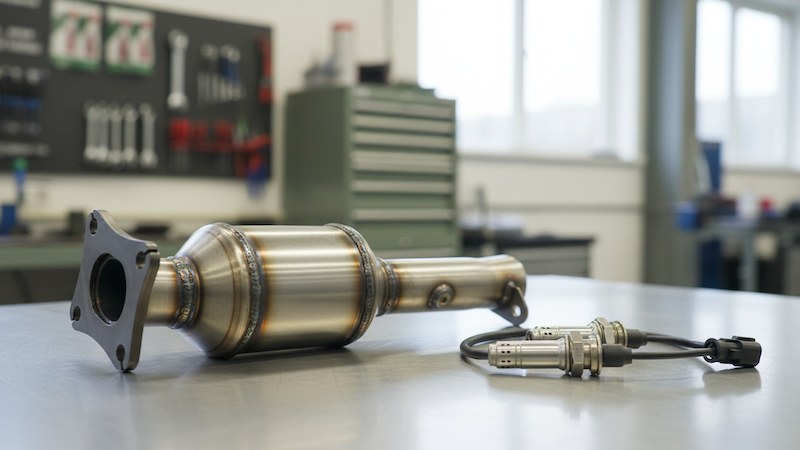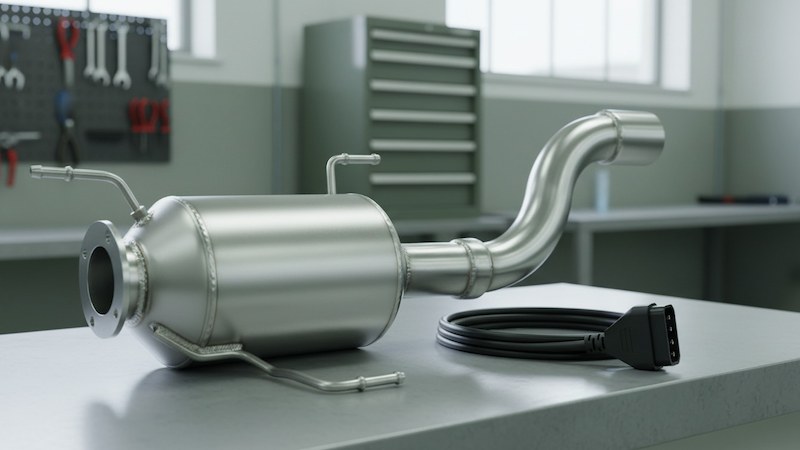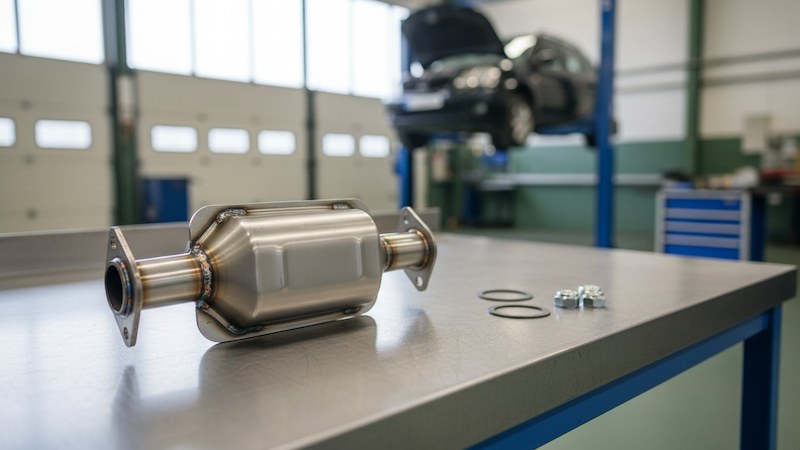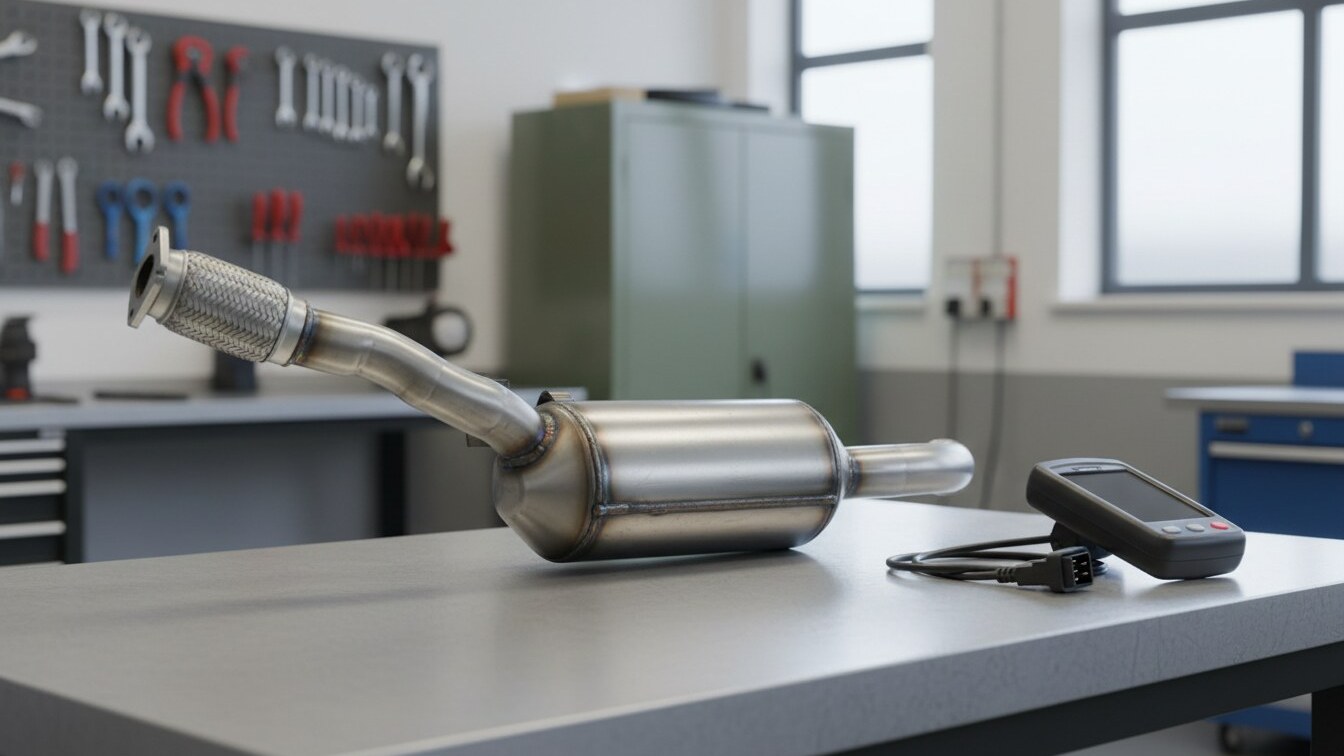
What does “Check anti-pollution system” mean? It means the engine computer has found a fault in the equipment that cleans your vehicle’s exhaust. On Renault and Dacia models such as the Clio, Megane and Jogger, the handbook says the message “indicates a fault in the vehicle’s particle filter system”, and a fault in the AdBlue “emissions reduction system” when the reagent tank warning light comes on with it1,3,4. On the 2014–2019 Renault Trafic it covers the whole “emission control system”2. Renault’s advice is to “drive very carefully” to a dealer “as soon as possible”, because ignoring it risks damaging the vehicle1,2.
The message names a system, not a part. The fault code stored in the engine computer says which part is at fault, and only some codes point to the catalytic converter or the diesel particulate filter (DPF). Peugeot and Citroën owners often know the same warning as an “anti-pollution fault”, from the French antipollution: where Peugeot’s French handbook says “Le système d’antipollution est défaillant”, the English edition says “The emission control system has a fault”5.
Below: what to do first, what the warning means on each make, how urgent it is, the MOT, how to find the cause, and what to do if the catalytic converter or DPF really has failed.
What to do when the warning comes on
- Look at the engine warning light. If it is steady, have the vehicle checked soon. If it flashes, ease off: keep the engine speed down until it stops flashing1,2. Peugeot, Citroën and Vauxhall handbooks link a flashing light to a risk of damaging the catalytic converter5,8,9.
- On a Renault diesel, check which lights are on. If the message comes up together with the emissions warning light and the general warning light, the handbook says to consult a dealer immediately1,2.
- Stop if the vehicle tells you to. A stop warning, such as “WARNING: Engine Failure Risk” on a Renault Clio or the STOP lamp on a Peugeot, means stop as soon as it is safe and call a dealer1,5.
- Have the fault codes read with a diagnostic tool, and note every code, not only the first.
- Don’t buy a part until the codes point to it. A new catalytic converter or DPF won’t cure a misfire, a sensor or an AdBlue fault.
What the warning means on each make
The wording differs by make and model, and so does what the warning covers. These are the manufacturers’ own descriptions, from their handbooks.
| Make and handbook | What you see | What the handbook says it means |
|---|---|---|
| Renault Clio (2023–2025 handbook), Renault Megane (2015–2019), Dacia Jogger (2025–2026) | “Check anti-pollution system” | “A fault in the vehicle’s particle filter system”; with the reagent tank warning light, a fault in the emissions reduction (AdBlue) system1,3,4 |
| Renault Trafic (2014–2019) | “Check antipollution system” | “A fault in the vehicle’s emission control system”; with the reagent tank warning light, the emissions reduction system2 |
| Renault (the models above) | The emissions warning light, which Renault calls the “toxic fume filter system” warning light | Steady: consult a dealer “as soon as possible”. Flashing: “reduce the engine speed until the light stops flashing”1,2 |
| Peugeot 207 (2009 handbook) and 208 (2015–2017) | The engine warning lamp | Steady: “The emission control system has a fault.” Flashing: “The engine management system has a fault”, with a “risk of destruction of the catalytic converter”5,6 |
| Peugeot and Citroën BlueHDi diesels | “Emissions fault” (in French, “Défaut antipollution”) | A fault in the SCR (AdBlue) emissions control system; once the fault is confirmed, a countdown, then the engine can’t be started5,8 |
| Citroën C3 (2010 handbook) | The “depollution system” warning lamp | Flashing or on while driving: “a problem with the depollution system”7 |
| Citroën Berlingo (2016–2017) | The “EOBD emission control system” lamp | Flashing or on: “a failure of the system”, with “a risk of damage to the catalytic converter”8 |
| Vauxhall Vivaro (2014 handbook) | The malfunction indicator light (no “anti-pollution” message) | Steady: “Fault in the emission control system”. Flashing: “Fault that could lead to catalytic converter damage”9 |
Petrol engines can have a particle filter too. Renault’s Clio handbook says it “is used in the treatment of exhaust gases from petrol engines”1, so “Check anti-pollution system” is not only a diesel warning. More in what is a GPF?
Steady or flashing: how urgent is it?
A flashing light is the urgent one. Renault asks you to reduce the engine speed until it stops flashing, then contact a dealer1,2. Peugeot warns of a “risk of destruction of the catalytic converter”5,6, and Vauxhall’s Vivaro handbook says “Ease up on the accelerator until the flashing stops” and get a workshop’s help immediately9.
The reason is written into the type-approval rules: the warning light must give a distinct warning, such as flashing, whenever the engine misfires at a level likely to damage the catalytic converter10. Renault’s handbook lists what can cause it: “a faulty ignition system, running out of fuel or disconnected spark plugs resulting in the engine misfiring” can make the catalytic converter overheat, which “may irreparably damage it”1. Unburned fuel that reaches the converter ignites inside it and can make its core overheat and melt13. A new converter fitted before the misfire is fixed would go the same way.
A steady light can wait a little, but not for months. Renault says to consult a dealer as soon as possible1,2; Peugeot says that if the lamp stays on after the engine starts, contact a dealer or qualified workshop “without delay”5.
Can I keep driving?
Usually as far as a garage, carefully: that is what the handbooks ask1,2. Three things change that:
- A flashing light or a stop warning. See above.
- An AdBlue countdown. On Peugeot and Citroën BlueHDi diesels, once an emissions fault is confirmed, “you can drive for up to 650 miles (1 100 km) before the engine starting inhibition system is triggered”; after that the message reads “Emissions fault: Starting prevented”5,8. A low AdBlue level has its own message, beginning “Top up emissions additive”5.
- A particle filter that needs cleaning. This has its own warning light. On the Renault Clio, keep driving as traffic allows until it goes out: on a diesel with the engine above 2,000 rpm if possible, for about 10 to 20 minutes; on a petrol between about 31 mph and 68 mph, for about 5 to 20 minutes1. If the filter becomes saturated, a warning light comes on with the message “Check injection”, and the handbook says to consult a dealer1. How regeneration works is in what is a DPF?
The text message itself goes away after a few seconds or when you press the display button, but it is stored in the computer’s log and the warning light stays on1,2. A message that has gone is not a fault that has gone.
Will it fail the MOT?
Yes, while the engine warning light is on. “Engine MIL inoperative or indicating a malfunction” is a major defect on petrol vehicles, including hybrids, with up to 8 passenger seats first used on or after 1 July 2003, and on diesels first used on or after 1 July 200811. On a diesel with a DPF, visible smoke of any colour from the exhaust is a major defect too, and so is evidence that the DPF has been tampered with11.
Clearing the codes just before the test doesn’t help if the fault is still there: the engine computer finds it again and turns the light back on. The rules let the light go out by itself only after three driving cycles in a row in which the fault is no longer found10. If the vehicle has already failed on emissions, see failed your MOT on emissions?
Find the cause: read the fault codes
Any garage with a diagnostic tool can read the stored codes, and a plug-in code reader shows them too. The code decides what happens next:
| The code says | It points to | Next step |
|---|---|---|
| P0420 or P0430: catalyst efficiency below threshold12 | The catalytic converter, or a leak, sensor or engine fault that makes it look worn: BM Catalysts say the code “doesn’t necessarily mean that the catalytic converter is at fault”12 | Our P0420 guide: the checks, in order |
| P2463 (soot) or P242F (ash) in the DPF12 | The DPF, or whatever stops it regenerating | DPF fault codes explained |
| P2452 or P2453: DPF pressure sensor circuit12 | The pressure sensor, its wiring and its pipes | DPF fault codes; DPF pressure pipes |
| A misfire code | Ignition (spark plugs, coils, leads), injectors or fuel supply | Fix it first: a misfire can destroy a catalytic converter1,13 |
| An oxygen (lambda) sensor code | The sensor or its wiring, or a real fuel-mixture fault it is reporting | Check the wiring and the fuel mixture before buying a sensor: a lambda failure “does not always mean the lambda sensor needs replacing”13 |
| An AdBlue (SCR) code, or the reagent tank light on | The emissions reduction (AdBlue) system1,2,5 | The AdBlue section of your handbook, then a dealer or specialist |
BM Catalysts, who make every part we sell, sum up the rule for converters: “All possible faults should be thoroughly investigated before condemning the catalyst”13. The same goes for a DPF: our guide to the causes to fix before replacing a blocked DPF lists what to check.
If the catalytic converter or DPF really is the cause
- Fix what damaged it first. A misfire, oil burning or an exhaust leak will damage a new part as well. The wider causes are in what causes a faulty catalytic converter?
- Match the part exactly. Look up your vehicle by registration on our homepage, or by make, model and engine on our vehicle pages. One model can have dozens: we list 43 catalytic converters for the Renault Clio, and the engine, year and Euro level decide which one fits.
- Check whether the cat and DPF are one unit. On many diesels they are, and the whole unit is replaced: of the 9 DPFs we list for the Renault Trafic, 7 are combined catalytic converter and DPF units.
- Do the DPF set-up. After fitting, the engine computer usually has to be told that a new DPF is on, and on Peugeot and Citroën diesels that use a fuel additive, the additive level matters too: a low level brings up its own warning and has to be topped up by a dealer or qualified workshop5. The full procedure is in how to replace a DPF.
- Type approval. Look for an H in our part number (homologated). Not every part we sell is type approved: see what homologated means.
- Fit it properly and clear the codes. Most of our catalytic converters and DPFs come with a fitting kit included. Clear the fault codes from the engine computer after fitting13. Step by step: fitting a catalytic converter.
- Keep the paperwork for the warranty: for a warning-light claim BM asks for the fault codes and what was checked or changed12.
Catalytic converters and DPFs for the vehicles that show these warnings
How many we list for each model on 23 October 2026. Each page lists every part by engine, with today’s price.
| Vehicle | Catalytic converters | DPFs, including combined units |
|---|---|---|
| Renault Clio | 43 | 2 |
| Renault Megane | 33 | 10 |
| Renault Scenic | 26 | 8 |
| Renault Trafic | 9 | 9 |
| Renault Master | 15 | 5 |
| Renault Kangoo | 19 | 3 |
| Dacia Sandero | 10 | 1 |
| Vauxhall Vivaro | 7 | 10 |
| Peugeot 207 | 11 | 12 |
| Peugeot 308 | 22 | 16 |
| Peugeot 3008 | 13 | 16 |
| Citroen C3 | 19 | 14 |
| Citroen Berlingo | 32 | 11 |
What these parts cost and what affects the price: how much does a replacement catalytic converter or DPF cost? Or browse all catalytic converters, DPFs and combined units.
Frequently asked questions
Can I reset “Check anti-pollution system” myself?
A code reader can clear the stored codes, and the message goes on its own after a few seconds anyway2. Neither fixes the fault. If it is still there, the engine computer finds it again and the light comes back; the light goes out by itself only after three driving cycles in a row without the fault10.
Does it mean the catalytic converter has failed?
Not on its own. Only some codes point to the converter, P0420 and P0430 for example, and even those don’t prove it12. A flashing light warns that the converter is at risk, for example from a misfire, rather than proving that it has already failed5,10.
Why does my Renault say “Check injection”?
On the Renault Clio, petrol and diesel, “Check injection” appears with a warning light when the particle filter has become saturated; the handbook says to consult a dealer1.
Does it mean the vehicle needs AdBlue?
Not by itself. On a Renault it concerns the AdBlue system when the reagent tank warning light comes on with it1,2. On Peugeot and Citroën BlueHDi diesels, “Emissions fault” is a fault in the AdBlue (SCR) system, while a low AdBlue level shows “Top up emissions additive”5.
What is the equivalent on a Vauxhall Vivaro?
The 2014 Vivaro handbook we checked has no “anti-pollution” message. It uses the malfunction indicator light: steady means “Fault in the emission control system. The permitted emission limits may be exceeded”, and flashing means “Fault that could lead to catalytic converter damage”9. If its DPF needs cleaning and automatic cleaning doesn’t happen, two control indicators come on and the handbook says to get a workshop’s help immediately9. Parts: Vauxhall Vivaro catalytic converters and DPFs.
Sources (accessed 23 October 2026)
- Renault, Clio 5 owner’s manual (edition 2 June 2023 to 16 March 2025): “Operating fault messages”, “Warning lights”, “Maintenance and antipollution advice”, “Special features of petrol versions” and “Special features of Diesel versions”. user-manual.renault.com
- Renault, Trafic 3 phase 1 owner’s manual (8 April 2014 to 3 March 2019): “Trip computer and warning system: operating fault messages”, “Warning lights”, “Maintenance and antipollution advice” and “Special features of diesel versions”. user-manual.renault.com
- Renault, Megane 4 owner’s manual (2 October 2015 to 28 November 2019): “Trip computer and warning system: operating fault messages”. user-manual.renault.com
- Dacia, Jogger owner’s manual (15 October 2025 to 25 May 2026): “Operating fault messages”. user-manual.dacia.com
- Peugeot, 208 handbook, edition 01-16 (June 2015 to January 2017), English and French editions: “Warning and indicator lamps”, “AdBlue and SCR system” and “Diesel additive”. public.servicebox.peugeot.com
- Peugeot, 207 handbook, edition 02-09 (June 2009 to February 2010): “Warning lamps”. public.servicebox.peugeot.com
- Citroën, C3 handbook, edition 01-10 (January to June 2010): “Illuminated warning lamps”. service.citroen.com
- Citroën, Berlingo handbook, edition 02-16 (October 2016 to February 2017): warning lamps and “AdBlue and SCR system”. service.citroen.com
- Vauxhall, Vivaro Owner’s Manual, model year 2014 (edition March 2014): “Malfunction indicator light” and “Diesel particle filter”. vauxhall.co.uk
- UN/ECE Regulation No 83, Annex 11 (on-board diagnostics), paragraphs 3.5.2 and 3.7.2, applied in Great Britain through Regulation (EU) 2017/1151, Annex XI. The same wording first appeared in Directive 98/69/EC, Annex XI, linked here. legislation.gov.uk
- DVSA, MOT inspection manual for private passenger and light commercial vehicles, section 8: Nuisance (8.2.1.2, 8.2.2.1 and 8.2.2.2), updated 14 October 2026. gov.uk
- BM Catalysts, “DPF & Catalytic Converter Common Fault Codes Guide” (FAULTCODES_V01, January 2024). bmcats.com
- BM Catalysts, “Catalytic Converter Warranty & Fitting Advice”, sections “Catalyst replacement guide” and “Warranty advice”. bmcats.com