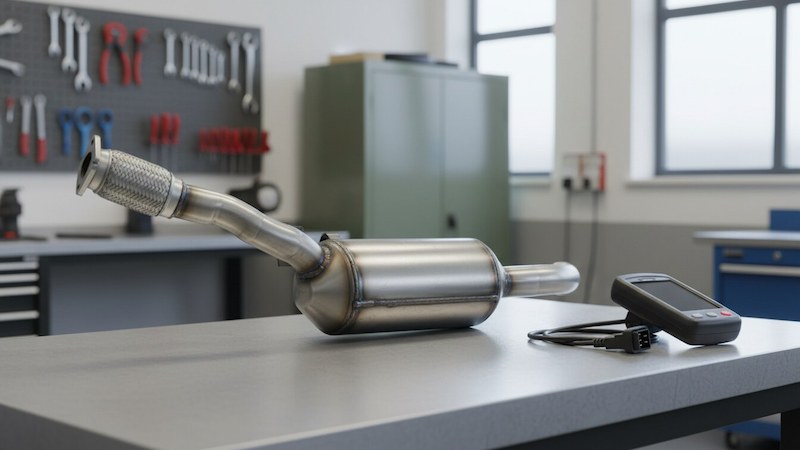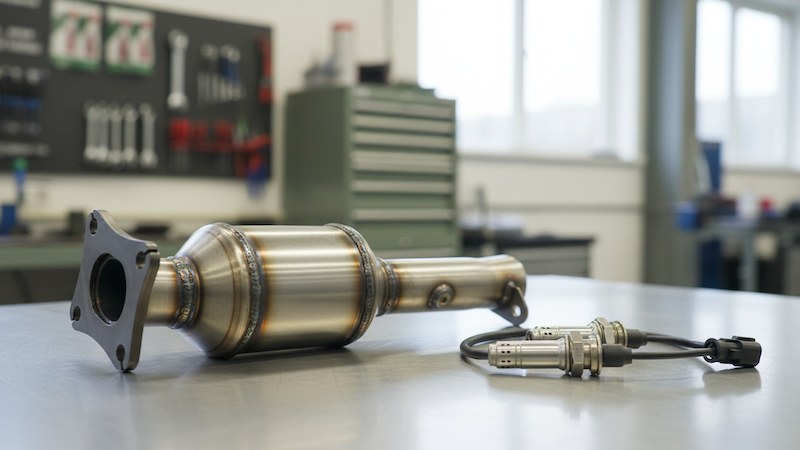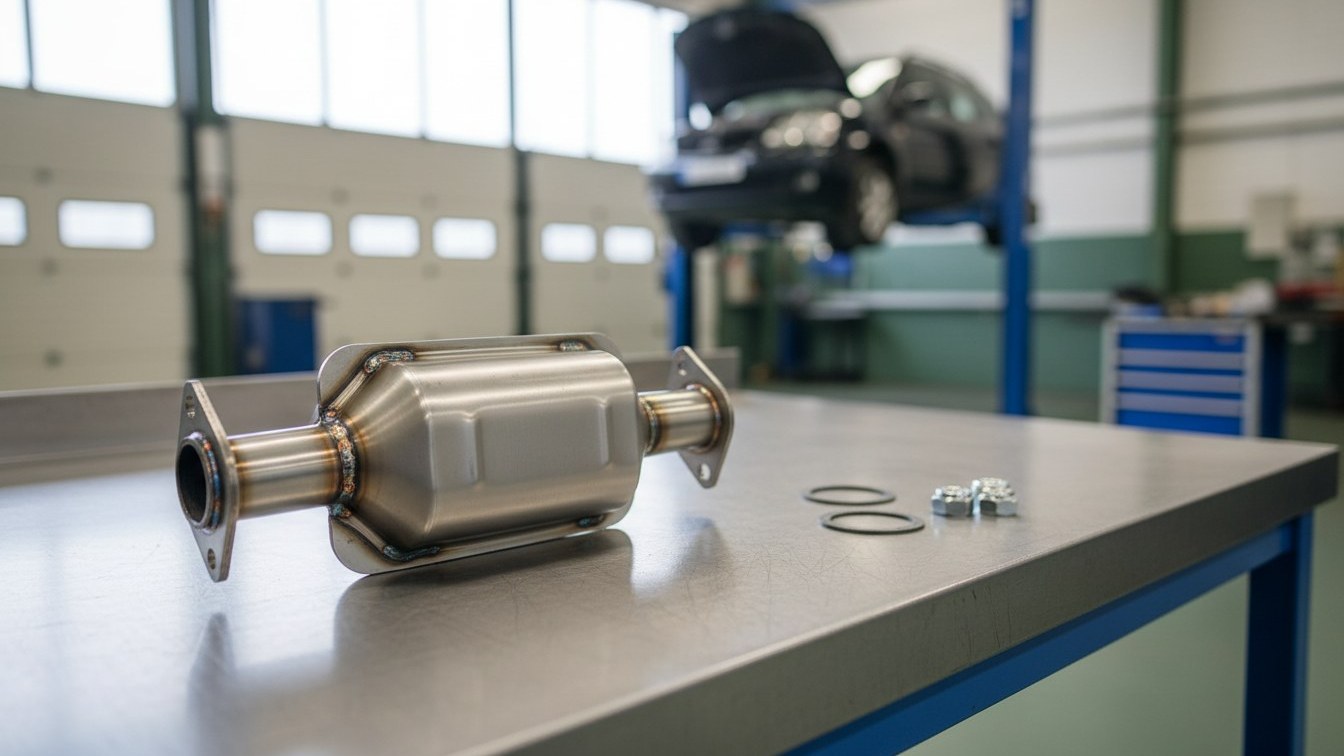
Homologated means type approved. A homologated catalytic converter or DPF is a replacement part that has been tested and approved by a government approval authority for a specific list of vehicles, and it carries a permanent approval mark to show it1,2. It’s the word in our product names, such as “Homologated Petrol Cat”, and what the H stands for in a BM Catalysts part number such as BM91752H3. Here’s what it means, when the law requires it in Ireland, and how to check a part.
The short answer
- Homologated = type approved: tested and approved as a replacement for the vehicles listed on its approval.
- Euro 5 and Euro 6 vehicles: a replacement catalytic converter, DPF or GPF must be type approved. EU law, which applies directly in Ireland, requires the sale or fitting of one that isn’t to be prohibited.
- Older vehicles: a replacement catalytic converter must be approved too, unless the vehicle was approved before the approval rules for replacement converters existed. A DPF for a Euro 4 or older diesel need not be.
- To check a part: look for the approval mark and the vehicle list, or ask for the type-approval certificate. In our range, look for an H after the digits of the part number and Type Approved on the product page.
What “homologated” means
EU type approval is the procedure by which an approval authority certifies that a type of vehicle, system, component or separate technical unit meets the relevant technical requirements1. A technical service, designated by the approval authority, carries out the tests1, and the authority that granted the approval must check that the manufacturer goes on producing parts that conform to the approved type, which is called conformity of production1. In Ireland the approval authority is the National Standards Authority of Ireland (NSAI)4.
UN Regulation 103 sets out how replacement catalytic converters are approved. The Euro 5 and Euro 6 rules use its tests, with some changes, for every replacement “pollution control device”, the law’s term for the parts that control and limit a vehicle’s emissions, and they name catalytic converters and particulate filters as pollution control devices, so DPFs and GPFs are covered too2. The replacement is tested on a vehicle in place of the original part and checked for emissions, durability and compatibility with the vehicle’s on-board diagnostics (OBD), the system that monitors the emission controls and stores fault codes2.
An approval covers specific vehicles. Under the Euro 5 and Euro 6 rules a homologated part must come with the list of vehicles, with their years of manufacture, that it is approved for2. That is why a homologated part is listed against particular models and years. BM Catalysts, who make every part we sell, say their homologated range is tested in accordance with UN Regulation 1035.
When the law requires a homologated part
The rule is in Article 11 of the EU’s Euro 5 and Euro 6 Regulation, which applies directly in Ireland6:
| Part | Vehicle | Must it be type approved? |
|---|---|---|
| Catalytic converter, DPF or GPF | Approved to Euro 5 or Euro 6 | Yes6 |
| Catalytic converter | Approved to an earlier standard, once approval rules for replacement catalytic converters applied (they date from 19987) | Yes6 |
| Catalytic converter | Approved before those rules existed | No: exempt6 |
| DPF | Euro 4 or earlier | No: the EU approval rules for replacement particulate filters cover vehicles approved to Euro 5 and Euro 62,6 |
Euro 5 applies to new cars and the smallest vans registered from 1 January 2011, although new models had to meet it from 1 September 20096. A vehicle’s type approval comes before its first registration, often by years, so for an older vehicle the registration date alone may not settle it: if you’re not sure, ask us before you order. Our Euro emissions standards guide explains the levels.
The rules are enforced against businesses. In Ireland it is an offence for a business to make available on the market a component that is subject to approval without that approval, with fines of up to €100,000 on conviction on indictment4. Our guide to type approval and the law has the detail.
Homologated, original, non-homologated and universal
- Original replacement: the vehicle manufacturer’s own part, marked with the manufacturer’s name or trade mark and part number and listed for the vehicles it fits2.
- Homologated (type approved): an aftermarket part approved as a replacement for the vehicles on its approval2.
- Non-homologated: not approved, so it can be fitted only where the law does not require approval, such as a DPF for a Euro 4 or earlier vehicle2,6.
- Universal: a catalytic converter made to be adapted to many exhausts. BM Catalysts, for example, make their universal cats without necks so that pipe stubs of the required bore can be welded in8. Where the law requires an approved part, one can be fitted only if its approval covers your vehicle6.
Does the NCT check for a homologated part?
Not directly. The inspector checks that the emission control system fitted by the manufacturer is present, complete, properly connected and not bypassed, and fails a vehicle if it is absent, modified (on a petrol vehicle), incomplete or obviously defective. A catalytic converter, DPF or EGR valve that was fitted when the vehicle was made but is now missing is a major fault. The emissions are measured too9. None of these checks covers the approval mark.
So a pass does not prove a part is approved, and selling a non-approved part where the law requires an approved one is still an offence for the business that sells it4.
What homologated means when you buy one
- Fit and Euro level. The approval ties the part to particular vehicles and their Euro level. BM Catalysts point out that parts for different vehicles and Euro levels can share the same housing and pipework yet differ inside, so a part that can be made to fit is not necessarily approved for your vehicle10.
- Emissions. A homologated part has been tested on a vehicle in place of the original2, but it cannot make up for an engine fault: the cause of the old part’s failure has to be fixed first, or the new one can be damaged too11. See failed your NCT on emissions?
- Warranty. Our catalytic converters and DPFs carry a 2-year warranty, 3 years on Premium silicon-carbide DPFs, covering manufacturing defects. BM Catalysts exclude, for example, impact damage, oil fouling and exhaust paste used in front of a catalytic converter11. See how to claim.
How to tell if a part is homologated
- Look for the approval mark. An approved replacement catalytic converter or DPF for a Euro 5 or Euro 6 vehicle bears an EU approval mark: a lower-case “e” in a rectangle followed by the distinguishing number of the member state that granted the approval, with the approval number next to it2. The number for Ireland is 2412. Parts approved under the UN scheme carry a capital “E” mark instead13. Wherever possible, the mark should be visible once the part is fitted2.
- Check the vehicle list. The part must be clearly marked with its manufacturer’s name or trade mark and come with the list of vehicles it is approved for. If your vehicle is not on it, the part is not approved for it2.
- Ask for the certificate. If in doubt, ask the seller or the manufacturer for a copy of the type-approval certificate.
In our range, homologated parts have an H at the end of the part number (HP on Premium DPFs) and show Type Approved on the product page, which lists the vehicles, years and Euro level each part is catalogued for (see BM Catalysts part numbers explained). Each BM unit also has a serial number of six letters beginning with C or D, usually pin-stamped on its body: note it before fitting, as it is needed for any warranty query11.
Approvals across the EU
An approval does not have to come from Ireland. EU member states may not prohibit, restrict or impede the sale of components that comply with the EU type-approval rules1, so a part approved by the authority of any member state can be sold here. The EU is also a party to the UN agreement behind UN approvals14, and the Euro 5 and Euro 6 rules build on UN Regulation 103 for replacement parts2.
Finding a homologated part for your vehicle
Every part we sell is manufactured by BM Catalysts. Every combined catalytic converter and DPF, catalytic converter and GPF and SCR and DPF unit in our range is type approved, and so is every catalytic converter and DPF we list for a Euro 5 or Euro 6 vehicle. Among our catalytic converters and DPFs, the parts without an H are catalytic converters listed for Euro 1 and Euro 2 vehicles and for some imported vehicles, and DPFs for Euro 3 and Euro 4 diesels. Most parts come with a fitting kit included, all carry at least a 2-year warranty and are backed by our fitment guarantee, and we deliver to the Republic of Ireland for €30.99 per order, usually within 2 to 3 working days of dispatch. Enter your vehicle below to see the parts catalogued for it, or choose it from the vehicle list.
Sources (accessed 29 October 2026, except 3, 5, 8, 10 and 11: 3 October 2026)
- Regulation (EU) 2018/858 (approval and market surveillance of motor vehicles), Article 3 (definitions of “EU type-approval” and “technical service”), Article 6(5) and Article 31 (conformity of production). eur-lex.europa.eu
- Commission Regulation (EU) 2017/1151, Article 10 and Annex XIII: type approval of replacement pollution control devices (points 2 to 5). eur-lex.europa.eu
- BM Catalysts, “Get to know our part numbers” (2024). bmcats.com
- European Union (Road Vehicles: Type-Approval and Market Surveillance) Regulations 2020 (S.I. No. 556 of 2020), regulations 4 and 17. irishstatutebook.ie
- BM Catalysts, company brochure (November 2023), page 7: manufacturing. bmcats.com
- Regulation (EC) No 715/2007 (Euro 5 and Euro 6), Article 10 and Article 11(1) to (3). eur-lex.europa.eu
- Commission Directive 98/77/EC of 2 October 1998, Article 3: replacement catalytic converters. eur-lex.europa.eu
- BM Catalysts, “Universal catalysts”. bmcats.com
- Road Safety Authority, National Car Test (NCT) Manual 2023, version 5.1, section 8.2 (8.2.1.1 and 8.2.2.1: exhaust emissions control equipment). ncts.ie
- BM Catalysts, “Euro level compliance”. bmcats.com
- BM Catalysts, “Catalytic Converter Warranty & Fitting Advice” (serial numbers, installation guide, warranty advice). bmcats.com
- Commission Implementing Regulation (EU) 2020/683, Annex V, point 1.1 (distinguishing numbers: 24 for Ireland). eur-lex.europa.eu
- Vehicle Certification Agency, “What is Vehicle Type Approval?” (page updated 15 May 2024). vehicle-certification-agency.gov.uk
- Council Decision 97/836/EC of 27 November 1997 on the accession of the European Community to the UNECE 1958 Agreement, Article 1. eur-lex.europa.eu