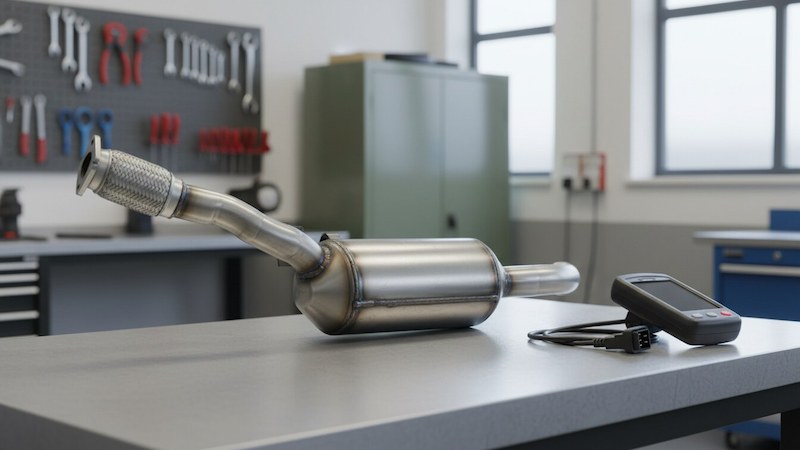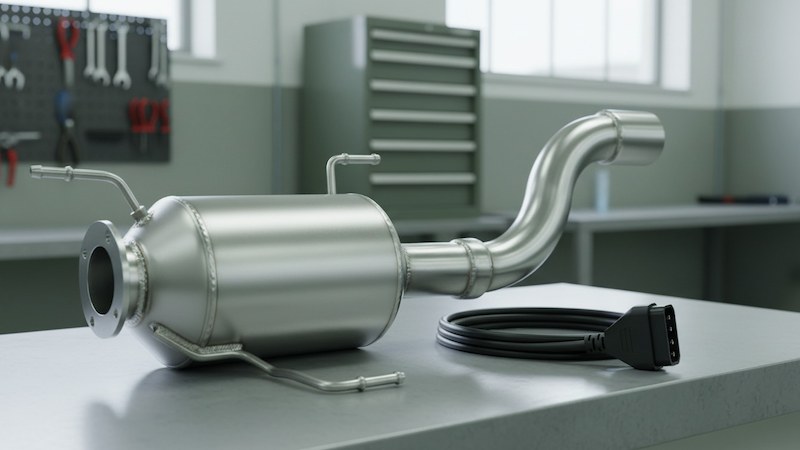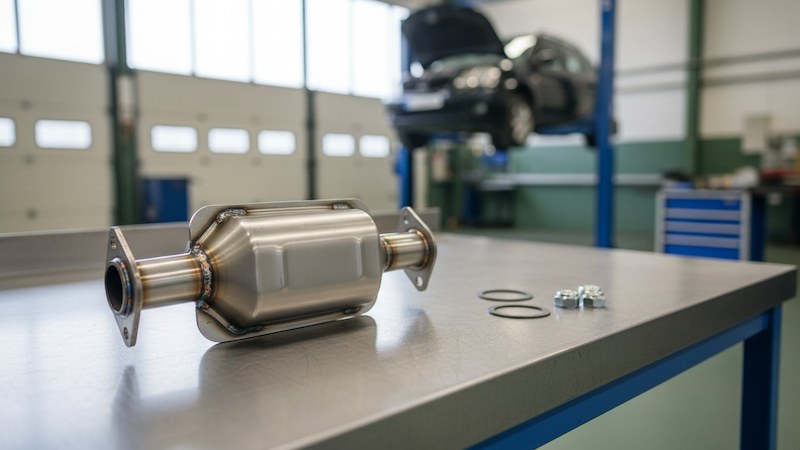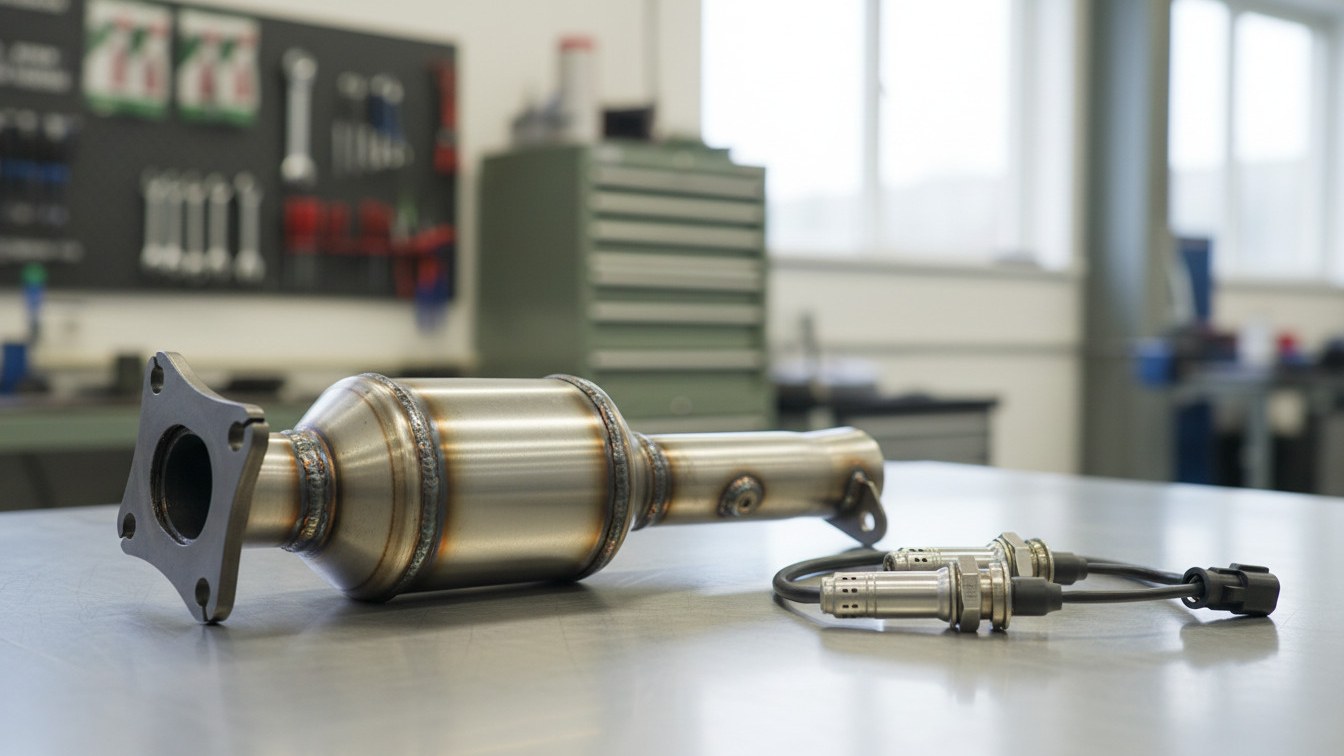
What does P0420 mean? P0420 is the standard fault code for “catalyst system efficiency below threshold, bank 1”1,2. The engine computer has compared the oxygen sensors in front of and behind the catalytic converter and decided that the converter is no longer cleaning the exhaust as well as it must. BM Catalysts, who make every part we sell, point out that this “doesn’t necessarily mean that the catalytic converter is at fault”1: an exhaust leak, an oxygen (lambda) sensor fault or an engine that isn’t running properly can set the same code1,3. Rule those out first. If the converter really has failed, find what damaged it before a new one goes on.
Below: what the related codes mean, how the engine computer reaches its verdict, the checks to make in order, whether you can keep driving, the MOT, and what to do when the converter is the cause. The wider causes of converter failure are in what causes a faulty catalytic converter?, and diesel particulate filter codes in DPF fault codes explained. If your Renault, Dacia, Peugeot or Citroën showed a message such as “Check anti-pollution system” rather than a code, start with what that warning means.
P0420 and the related codes at a glance
| Code | Description | Which bank |
|---|---|---|
| P0420 | Catalyst system efficiency below threshold1 | Bank 1 |
| P0430 | Catalyst system efficiency below threshold1 | Bank 2 |
| P0421 | Warm up catalyst efficiency below threshold4 | Bank 1 |
| P0431 | Warm up catalyst efficiency below threshold4 | Bank 2 |
Every engine has a bank 1, so P0420 can appear on any vehicle; P0430 only on an engine with a second bank. Some scan tools add two more characters, as in P042000: they are a “failure type” sub-code from the same standard2, so look up the first five.
How the engine computer decides the converter isn’t working
A catalytic converter is watched by two oxygen sensors, one upstream (before it) and one downstream (after it)1. The upstream sensor’s reading normally fluctuates, while the downstream sensor’s should stay steady. If both sensors give similar readings, the engine computer calculates that the converter is not working as intended and sets the code1.
Two things follow. First, the code is triggered by the sensor readings “rather than by measuring vehicle emissions”1, so anything that upsets those readings, such as a leak near a sensor or a sensor that is failing, can set it while the converter still works. Second, the limit isn’t arbitrary. Type-approval law, which still applies in Great Britain, requires the on-board diagnostics to treat a converter as malfunctioning once its loss of efficiency lets hydrocarbon or nitrogen oxide emissions exceed set limits; manufacturers may monitor the front converter alone or together with the ones behind it5.
Bank 1 or bank 2: which converter is it?
Bank 1 is the bank of cylinders that includes cylinder number 1; bank 2, where there is one, is the other6. An engine with its cylinders in a single row may be treated as one bank, bank 1, for all its cylinders, or divided into two6. Engines with two banks, such as many V6 and V8 engines, can have a converter and oxygen sensors on each bank6, and P0430 is the same fault on bank 21. The sensors are numbered from the engine backwards, sensor 1 being the closest to the engine6, so a garage may talk about the “bank 1 sensor 2” oxygen sensor, for example.
Some vehicles have more than one converter in a row, and P0420 doesn’t always say which one is at fault. On some Kia petrol engines sold in the US, for example, the procedure for P0420 checks the warm-up converter, which is replaced together with the exhaust manifold, as well as the under-floor converter behind it7. P0421 and P0431 point at the warm-up converter specifically: Mitsubishi found them set by converters mounted on the exhaust manifold whose catalyst layer had separated4.
Symptoms
Often there are none you can feel: BM notes that there “may not be any driveability issues” with these codes1. When there are, they may include1:
- the engine management light on;
- less power or poor acceleration;
- higher fuel consumption;
- a rotten-egg (sulphur) smell from the exhaust.
A rattle from under the vehicle can mean the converter’s ceramic core has broken up, usually after an impact. Check that it isn’t a vibrating heat shield or a loose baffle first, which BM says can be wrongly identified as a rattling converter3.
What causes P0420?
BM Catalysts lists these possible causes1:
- a damaged exhaust pipe or a leak in the exhaust system, or a leak from the exhaust manifold;
- an engine misfire;
- a leaking fuel injector, or fuel pressure that is too high;
- a faulty oxygen sensor, or faulty sensor wiring or connections;
- a faulty engine coolant sensor;
- the wrong fuel;
- oil contaminating the converter;
- and a converter that no longer works properly, possibly because of one or more of the above.
Its catalytic converter guide adds retarded ignition timing, and sums up: “All possible faults should be thoroughly investigated before condemning the catalyst”3.
What to check before replacing the catalytic converter
In roughly this order, the cheapest and most likely first:
- Read every stored code, not just P0420. A misfire, fuel-mixture or sensor code logged alongside it points to the cause.
- Look for exhaust leaks from the manifold back, especially near the sensors. BM’s method: with the exhaust cold, look for cracks, holes and soot marks (soot builds up where gas escapes); if nothing shows, connect a vacuum cleaner to the tailpipe and spray soapy water along the system, and bubbles mark the leak8. It warns against pressurising an exhaust that is blocked at one end, which can reveal “leaks” that don’t exist in normal use8. An exhaust leak that could affect emissions is an MOT failure in its own right9.
- Check the oxygen sensors and their wiring. A sensor fault can make a working converter look worn. Equally, an air-fuel (lambda) reading out of range “does not always mean the lambda sensor needs replacing”3: it may be reporting a real problem with the fuel mixture.
- Check how the engine runs: misfires (spark plugs, leads, coils), injectors, fuel pressure, the coolant sensor and the ignition timing1,3.
- Check for oil burning. Oil getting into the exhaust contaminates the converter until it can no longer convert3.
- Ask a dealer about software updates. Manufacturers sometimes fix P0420 with new engine software. On some US-market models, Honda’s fix for the CR-Z hybrid was a software update, after which “a need for parts replacement will be unlikely”10, and Volkswagen updated a Passat V6’s engine software “to avoid unnecessary catalyst replacement”11. A dealer can tell you whether a bulletin applies to your vehicle.
- Then look at the converter. A blue or purple tint on the shell, or a melted or warped core, means it overheated on unburned fuel, which BM says is “always a sign there is a fault with the running of the vehicle” to be found before a replacement is fitted3. Dents and scratches with a rattle point to impact damage3.
Can I drive with a P0420 code?
The vehicle may drive normally, but BM’s advice is to deal with it “as soon as possible to avoid further complications or causing serious damage to other components”1. The bigger risk is often the cause rather than the code. A misfire sends unburned fuel into the converter, where it ignites and can overheat and melt the core3, and a new converter would go the same way.
Watch how the engine management light behaves. Type-approval rules require it to give a distinct warning, such as flashing, whenever the engine misfires at a level likely to damage the catalytic converter12. If yours flashes, ease off and have the vehicle checked straight away. And while the light is on, the vehicle will fail its MOT.
Will P0420 fail the MOT?
Yes, while the engine management light is on. On petrol vehicles, including hybrids, with up to 8 passenger seats and first used on or after 1 July 2003, a malfunction indicator lamp “indicating a malfunction” is a major defect9. On diesels the same check applies from 1 July 20089.
The emissions test can fail too: a carbon monoxide (CO) failure means the converter is not able to convert all the gases that pass through it3. How to read the printout is in failed your MOT on emissions? On a petrol vehicle first used on or after 1 September 2002, emission control equipment that is missing, obviously modified or obviously defective is a major defect as well9.
Clearing the code just before the test doesn’t fix anything. If the fault is still there, the engine computer finds it again as you drive, logs the code and turns the light back on. The rules let the light go out by itself only after three driving cycles in a row in which the check no longer finds the fault12, and a stored code may be erased only after 40 engine warm-ups or driving cycles without it5.
If the catalytic converter is the cause
- Match the part to the vehicle exactly. Converters differ by engine, years and emissions standard (Euro level), so search by registration, or by make, model and engine, on our vehicle pages. Our Euro standards guide explains why the level matters.
- Type approval. Where the law requires an approved replacement, look for an H in our part number (homologated). Not every part we sell is type approved: see what homologated means and what UK law requires.
- Newer petrol engines may have a combined unit. On some, the converter and the petrol particulate filter (GPF) are one part, and the whole unit is replaced. On the Peugeot 208 1.2, for example, we list separate converters for most engines from 2012 and combined catalytic converter and GPF units for several engines from 2019: the engine code decides which. More in what is a GPF?
- Fit it properly. Our fitting guide goes through it step by step, and most of our converters come with a fitting kit. Never use exhaust paste in front of a converter: it hardens, breaks off and damages the core, and voids the warranty3. After fitting, clear the fault codes from the engine computer3.
- Keep the paperwork. The warranty covers manufacturing defects, not damage caused by a fault on the vehicle, and BM will not accept an emissions-failure claim with a hydrocarbon reading over 60 ppm3. For a warning-light claim it asks for the fault codes and what was checked or changed1. See how to claim on the warranty.
If P0420 comes back after a new converter has been fitted, look elsewhere: a new converter cannot cure a code set by a leak, a sensor or an engine fault.
Converter prices for vehicles people search P0420 for
The cheapest petrol catalytic converter we list for each vehicle, including VAT, on 17 October 2026, and how many we list. Each vehicle links to its page, which lists every part by engine with today’s price; the one yours needs depends on its engine, year and Euro level.
| Vehicle | Petrol converters listed | From |
|---|---|---|
| Ford Fiesta | 35 | £73.99 |
| Ford Focus | 20 | £89.99 |
| Peugeot 207 | 6 | £88.99 |
| Peugeot 208 | 5 | £148.99 |
| Vauxhall Corsa | 29 | £70.99 |
| Vauxhall Astra | 59 | £66.99 |
| Toyota Yaris | 21 | £90.99 |
| Nissan Micra | 17 | £68.99 |
| Honda Jazz | 6 | £90.99 |
| Citroen C3 | 9 | £88.99 |
| Volkswagen Polo | 65 | £67.99 |
| MINI Cooper | 5 | £183.99 |
More vehicles, DPFs and what affects the price: how much does a replacement catalytic converter or DPF cost? Or browse all catalytic converters.
Frequently asked questions
Does P0420 mean the same on every make?
Yes. P0420 is a standard code2, and manufacturers’ own bulletins describe it the same way, Honda’s10 and Volkswagen’s11 among them. What differs is the part: how many converters the vehicle has, where they sit, and whether the converter is combined with a GPF.
Can a bad oxygen sensor cause P0420?
Yes. BM lists a defective oxygen sensor, and faulty sensor wiring or connections, among the causes1. The code is based on the sensors’ readings, so a sensor that reads wrongly can make a good converter look bad.
What is the difference between P0420 and P0430?
Only the bank: P0420 is bank 1 and P0430 is bank 21. When both appear on a V6 or V8, look first for something both banks share. Audi and Volkswagen have each fixed P0420 and P0430 together on V6 engines with an engine software update11,13.
How much does it cost to fix P0420?
It depends on the cause. Repairing an exhaust leak or a sensor usually costs far less than a converter. If the converter is the cause, the cheapest petrol converters we list for the vehicles above range from £66.99 (Vauxhall Astra) to £183.99 (MINI Cooper) including VAT, on 17 October 2026; labour depends on the vehicle and the garage.
Will an oxygen sensor spacer or a “cat delete” tune fix P0420?
No. They stop the engine computer from seeing the fault, but the converter still isn’t cleaning the exhaust. Emission control equipment that has been obviously modified is a major MOT defect9, and our guide to type-approved catalytic converters and the law explains the rules on removing or altering one.
Sources (accessed 17 October 2026)
- BM Catalysts, “DPF & Catalytic Converter Common Fault Codes Guide” (FAULTCODES_V01, January 2024), sections “P0420/P0430” and “Warranty guidance”. bmcats.com
- SAE International, J2012 “Diagnostic Trouble Code Definitions”, December 2016. saemobilus.sae.org
- BM Catalysts, “Catalytic Converter Warranty & Fitting Advice”, sections “Catalyst replacement guide” and “Warranty advice”. bmcats.com
- Mitsubishi Motors North America, Technical Service Bulletin TSB-13-15-001, December 2013 (DTC P0421 or P0431, “Warm Up Catalyst Efficiency Below Threshold”), published by the US National Highway Traffic Safety Administration. static.nhtsa.gov
- Regulation (EU) 2017/1151, Annex XI (on-board diagnostics), points 2.1.4 and 2.1.9, as it applies in Great Britain. legislation.gov.uk
- Vermont Department of Environmental Conservation, “On-Board Diagnostics: O2S Location Identification”. dec.vermont.gov
- Kia Motors America, Technical Service Bulletin 160 (Rev. 1, 15 November 2016), “ECU upgrade: MIL on with DTC(s) P0420/P0171”. static.nhtsa.gov
- BM Catalysts, “Exhaust Leaks & Pressure Testing” (ELPT_V01). bmcats.com
- DVSA, MOT inspection manual for private passenger and light commercial vehicles, section 8: Nuisance (8.2.1.1, 8.2.1.2 and 8.2.2.2). gov.uk
- American Honda, Service Bulletin 22-040, “MIL is on with DTC P0420”, 21 September 2022. static.nhtsa.gov
- Volkswagen of America, Technical Bulletin 01 16 10, “Update programming, MIL on, DTCs P0420 and or P0430 stored in ECM fault memory”, 27 June 2016. static.nhtsa.gov
- UN/ECE Regulation No 83, Annex 11 (on-board diagnostics), paragraphs 3.5.2 and 3.7.2, applied in Great Britain through Regulation (EU) 2017/1151, Annex XI, point 2.1. The same wording first appeared in Directive 98/69/EC, Annex XI, linked here. legislation.gov.uk
- Audi of America, Technical Service Bulletin 01 14 95, “MIL on (DTC P0420 and/or P0430 in ECM)”, 26 September 2014. static.nhtsa.gov