You start the engine and it roars. If your vehicle was fine yesterday, the most likely explanation is that someone has cut the catalytic converter out of the exhaust overnight. It’s a common crime, it takes thieves only minutes, and it’s upsetting and inconvenient. This guide takes you through what to do, in order, and how to make it less likely to happen again.
How to tell it’s been stolen
- A sudden, very loud exhaust when you start the engine, getting louder as you rev. The converter sits in the exhaust between the engine and the rear silencer, so cutting it out leaves an open pipe.
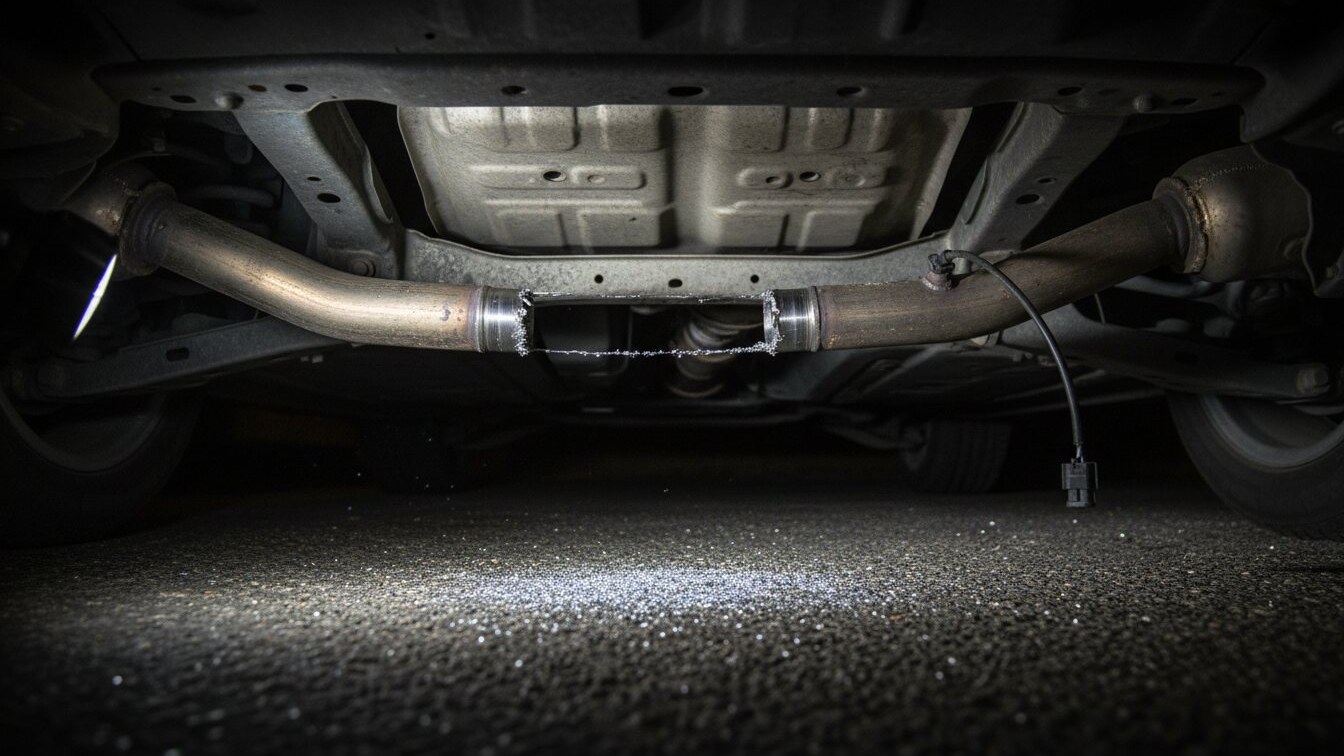
- Signs underneath. Looking under the vehicle from the side, without getting underneath, you may see two freshly cut pipe ends with a gap between them, and metal filings on the ground.
- A warning light. Sensor wires near the converter can be cut too, which may bring on the engine management light.
Why catalytic converters are stolen
A catalytic converter contains small amounts of platinum, palladium and rhodium, precious metals whose value makes the part a target1. Hybrids are particularly attractive to thieves: their converters see less use, so the metals inside are in better condition1. Vans and SUVs are targeted because their ground clearance makes the underside easy to reach1. In advice last updated in November 2023, the insurer Admiral named the pre-2015 Honda Jazz (later models have the converter under the bonnet), the Toyota Prius, the Toyota Auris and the Lexus RX as the vehicles most likely to have their catalytic converter stolen2.
What to do next, step by step
1. Don’t drive it
Driving without the converter isn’t just noisy. The law requires every vehicle to have an exhaust system with a silencer that the exhaust gases pass through3. For vehicles first used after 1 January 2001, it also requires emission control equipment to be kept in good and efficient working order4. A vehicle with its converter cut out meets neither. Arrange for it to be recovered to a garage, or ask a garage whether they can come to you. Your insurer or breakdown cover may arrange this.
2. Report it to the police
Report the theft on 101, or through your local police force’s website. Call 999 only if the theft is happening now. You’ll be given a crime reference number: keep it, because your insurer will ask for it. If you have doorbell or CCTV footage, mention it when you report.
3. Tell your insurer
Theft of a catalytic converter is usually covered by a comprehensive policy under theft cover1, and your policy excess will apply. Ask your insurer early how they want the repair handled: some send the vehicle to an approved repairer, others let you choose a garage and claim the cost. Keep every receipt.
4. Get the right replacement fitted
The replacement must be the right part for your vehicle, and in most cases a type-approved one. Government guidance is clear: it is illegal to supply catalytic converters that are not type-approved for use on vehicles registered after 1 March 2001. Type-approved converters must be permanently marked with their approval5. A garage that quotes an unmarked or “universal” part for a modern vehicle is quoting the wrong part.
Ask the garage to check the rest of the exhaust at the same time. Thieves can damage the pipes either side of the converter and cut the oxygen sensor wiring, and these need repairing too. We supply matching connecting pipes, and where a part has a fitting kit (gaskets, clamps and fixings), it’s included in the price.
Use the part finder at the bottom of this page to find the correct converter for your vehicle. Every part is shown against the exact make, model and engine it fits, and type-approved parts carry an H at the end of the part number. Delivery is free to most UK addresses, and next-day on orders placed before 4pm, which matters when the vehicle is off the road. Our guide to type approval and the law explains the rules in more detail.
5. Protect the new one
A vehicle that has been targeted once can be targeted again. The measures recommended by Secured by Design, the police-owned crime prevention initiative, and by the RAC are:
- Mark the converter with a heat-resistant, police-approved security marking kit that gives it a unique, registered code. Secured by Design lists accredited products from Selectamark and DeterTech6. A marked converter is harder to sell and easier for police to trace.
- Fit a lock or cage. Secured by Design lists the Catloc device, which meets the Sold Secure SS102 Gold standard6. Tell your insurer before fitting any security device1.
- Park thoughtfully. Use a locked garage if you have one. Otherwise, park close to a wall or kerb, or between other vehicles, so the underside is hard to get at1. When away from home, choose a car park accredited under the Park Mark safer parking scheme6.
- Use your alarm. Make sure a factory alarm is switched on. Some can detect the vehicle being lifted or tilted. For vans without an alarm, consider an approved aftermarket one6.
- Light and cameras. Motion-activated lighting and a camera covering your driveway deter thieves and help police if the worst happens6.
Why marking helps: since the Scrap Metal Dealers Act 2013, scrap metal dealers must be licensed, must check the identity of anyone selling to them and may not pay cash7. A converter with a registered security code is much harder to pass off.
Getting back on the road
A stolen catalytic converter is a nuisance, but it is a straightforward repair once you have the right part. Report it, tell your insurer, and have a type-approved replacement fitted. Then protect it.
Sources (accessed 26 September 2026)
- RAC, “Catalytic converter theft – how to protect yours”. rac.co.uk
- Admiral, “Hybrid vehicles top target for catalytic converter thefts” (published 20 February 2020, updated 15 November 2023; since withdrawn from admiral.com: archived copy of 19 April 2026, accessed 13 October 2026). web.archive.org
- The Road Vehicles (Construction and Use) Regulations 1986, regulation 54. legislation.gov.uk
- The Road Vehicles (Construction and Use) Regulations 1986, regulation 61A. legislation.gov.uk
- Department for Transport, “Catalytic converters and diesel particulate filters” (published 30 May 2023). gov.uk
- Secured by Design, “Catalytic converter theft: how to prevent it”. securedbydesign.com
- Scrap Metal Dealers Act 2013. legislation.gov.uk