What does a DPF pressure sensor do? It tells the engine computer how full the diesel particulate filter (DPF) is. Two small lines carry exhaust pressure from just before and just after the filter to the sensor, and the difference between the two rises as soot builds up1,2. The engine computer uses that reading to decide when to burn the soot off, a process called regeneration1,2. If a pipe or hose splits, blocks or comes off, the reading is wrong, and the vehicle can behave as if the DPF itself has failed: warning lights, regenerations that don’t happen, lost power3,5. So check the pipes and hoses first, then the sensor, and the filter last2,4.
The short answer
- Symptoms: the engine warning light, loss of power or limp mode, black smoke and poorer fuel economy2,3,5.
- Usual causes: a split, cracked, melted or soot-blocked pipe or hose, an exhaust leak near the sensor’s pipes, a wiring or connector fault, or the sensor itself2,3,6.
- Fault codes: P2452 to P2455 point at the sensor’s circuit; P244A and P244B mean the pressure across the filter looks too low or too high2,3.
- Cost: our DPF pressure pipes cost €34.99 to €119.99, and a type-approved DPF on its own €154.99 to €547.99. Prices on 7 November 2026, in euro without VAT: Irish VAT and any customs duty are collected by the courier.
- The NCT: if the engine warning light stays on with the engine running, the smoke test isn’t carried out and the vehicle fails7.
Below: how the sensor and its pipes work, where to find them, the symptoms, what to check and in what order, the fault codes, the NCT, and how to choose the right pipe.
How the DPF pressure sensor works
A DPF fills with soot as it works. The fuller it gets, the harder the exhaust has to push through it, so the pressure in front of the filter rises compared with the pressure behind it. The differential pressure sensor measures that pressure drop across the filter, and the engine computer turns it into an estimate of how much soot the filter holds1,2. Bosch, which makes these sensors, describes the reading as the basis for regenerating the filter on demand, only when it needs it, which saves fuel1.
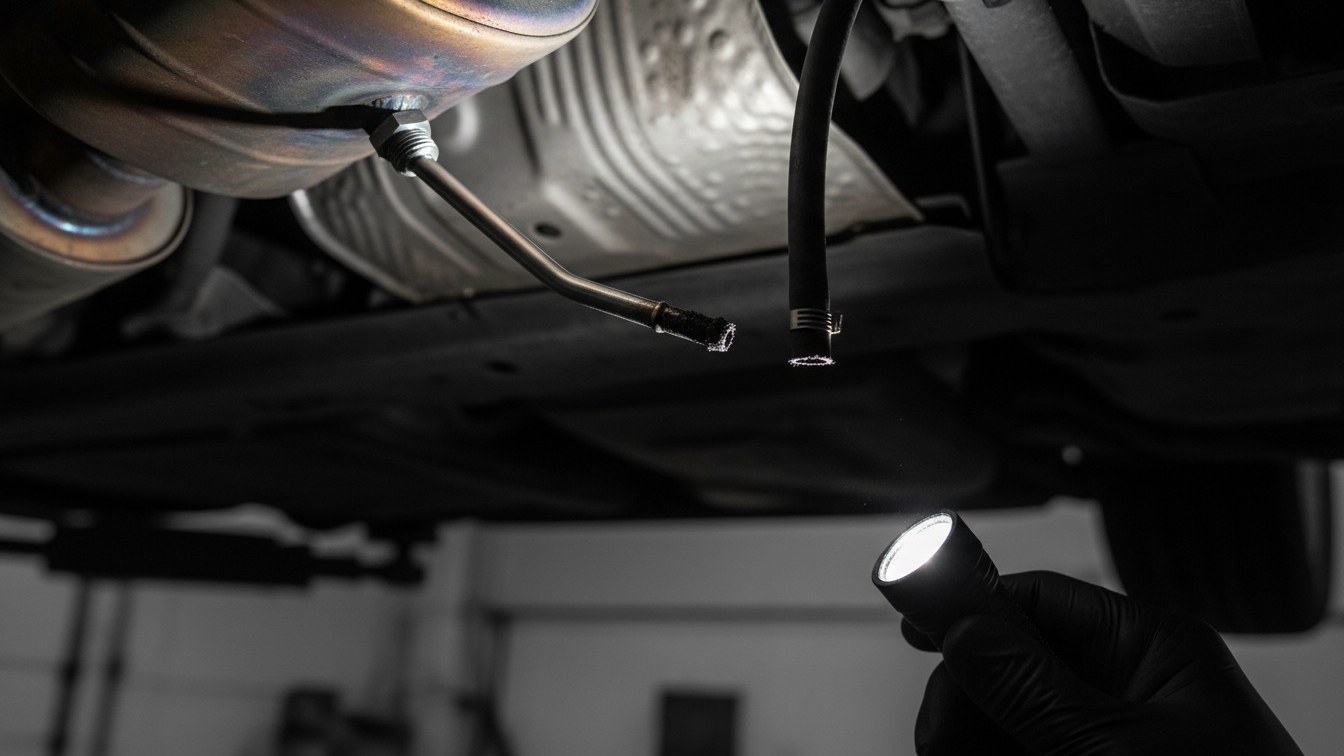
The sensor is connected to the exhaust by two lines: one tapped in before the filter and one after it2. Depending on the vehicle, the lines are rubber or silicone hoses2,3,4, or a rigid metal pipe from the filter joined by a short hose to the sensor. The DPF pressure pipes we sell are those metal sections: typically a bent metal tube that screws into the filter at one end, with a spigot for the hose at the other, and often a bracket to hold it in place.
Some vehicles also have a second differential pressure sensor elsewhere, for the exhaust gas recirculation (EGR) system1, so make sure any reading or part is the DPF one.
Where is the DPF pressure sensor?
Usually in the engine compartment, not on the filter: it is mounted away from the exhaust to protect it from the heat2,3, often at the back of the engine compartment2. The quickest way to find it is to follow the two small lines from the DPF. They end at a small sensor with two pressure connections and an electrical connector1,2. The exact place varies from vehicle to vehicle: the workshop data for your vehicle shows it.
Symptoms of a faulty DPF pressure sensor or pipe
A split, blocked or disconnected line gives the engine computer a reading that is too low, too high, frozen or missing altogether3,5. What you notice depends on which:
- The engine warning light, with a stored fault code3,6.
- Lost power, or limp mode. HELLA, the parts maker, describes how on the Dacia Dokker defective hoses or a faulty sensor can leave the engine computer with distorted or missing values. It then switches to emergency running to protect the engine, and the vehicle may only reach 80 to 100 km/h (about 50 to 60 mph)5. Mercedes-Benz lists reduced engine power and the engine warning lamp for differential pressure sensor faults on the Sprinter6.
- Black smoke, higher engine temperature and poorer fuel economy2,3.
- A DPF that blocks. If the sensor stops calling for regeneration, the filter can block completely and fail2. And when the pressure across the filter reads too low, the engine computer may decide the filter isn’t there at all, store P244A and switch active regeneration off3.
None of these is unique to the pressure sensor: a genuinely blocked filter shows most of them too. That is why the order of the checks matters.
Pipe, hose, sensor or filter: what to check first
BM Catalysts, the manufacturer of the DPFs we sell, says DPF fault codes are rarely caused by a defective filter. Its list of checks before a DPF is replaced starts with the pressure pipes and sensors: the pipes free from blockages, the sensors working correctly3,4. In practice, the order is:
- Look. With the engine cold, trace both lines from the filter to the sensor. Look for hoses that are cracked, split or melted, or have come off, and metal pipes that are cracked or rusted through. Check the sensor’s connector and wiring for damage too2,5.
- Clear or replace a blocked line. Soot from the exhaust can block the pipes and hoses, and a blocked line has to be cleared or replaced2.
- Look for exhaust leaks before or near the sensor’s pipes, which also upset the reading2,3.
- Read the sensor on a test drive. A garage watches the sensor’s live value with a diagnostic tool. If the value stays static or doesn’t follow the engine load, the sensor and its hoses come off for a closer look5.
- Then the sensor. If the lines and wiring are sound and the reading still doesn’t make sense, the sensor itself is faulty2. On the Sprinter’s V6 diesel, Mercedes-Benz found that a compound given off by the rubber hoses could settle on the sensor and damage it. Its fix was a new sensor and a full set of new hoses, with the instruction not to use hoses from old stock6.
- Only then the filter. If everything above checks out and the codes still point at the filter, look at the DPF, and at why it blocked: see blocked DPF? The causes to fix before replacing it.
After the repair, the fault memory is cleared and the vehicle test-driven5. A new sensor’s offset has to be programmed into the engine computer2, and if a new DPF is fitted, the engine computer must be reset and a forced regeneration run3,4.
The fault codes, in brief
| Code | What it means | Check first |
|---|---|---|
| P2452, P2453 | DPF pressure sensor circuit; circuit range or performance | Blocked hoses, the sensor, its wiring and connector, and whether regeneration is working3 |
| P2454, P2455 | DPF pressure sensor circuit low, high | The sensor and its wiring; an exhaust leak can also set these2 |
| P244A, P244B | Pressure across the filter too low, too high | Exhaust leaks before or near the sensor, leaks in its hose, modifications to the exhaust or engine3 |
A code tells a garage what to test, not which part to replace3. The other DPF codes, such as P2002, P2463 and P242F, are explained in our DPF fault codes guide.
Can I drive with a faulty DPF pressure sensor?
Only gently, and only as far as a garage. BM says the conditions behind P2452 and P2453 could lead to engine or fuel system damage and should be treated as a priority3. Without a believable reading, the engine computer may stop regenerating the filter or cut the power to protect the engine3,5. Carry on like that and the filter keeps filling with soot. Once it is completely blocked, a regeneration can’t clear it, and it has to be cleaned off the vehicle or replaced2 (see DPF cleaning: does it work, or do you need a new DPF?). A pipe costs a small fraction of that.
DPF pressure sensor faults and the NCT
The NCT manual says nothing about the DPF pressure sensor or its pipes, but the test does check what a fault often causes7:
- The engine warning light. Before the smoke test on a diesel, the tester runs some pre-checks. If the engine warning lamp indicates a defect, the smoke test is not carried out, and an engine warning light that stays on with the engine running is a major defect, so the vehicle fails7. Pressure sensor codes usually come with the engine warning light3, so fix the fault before the test.
- Smoke. Excess exhaust smoke likely to affect other road users is a fail, and so is a smoke meter reading above the limit: 1.5 m-1 for diesels first registered after 1 July 2008 and 0.7 m-1 for Euro 6 engines first registered after 1 September 2015, with higher limits for older diesels7. Black smoke is one of the symptoms BM lists for the pressure sensor codes P2452 and P24533.
- Stored fault codes. The tester also plugs a scanner into the diagnostic socket. For now, an error code found that way gives an “Advisory Pass” rather than a fail, because the NCT is bringing in its on-board diagnostics checks in phases. The NCTS still strongly recommends having any error codes dealt with7,8.
If the vehicle has already failed, see failed your NCT on emissions? What to do next.
Choosing the right DPF pressure pipe
We sell 333 pressure pipes for 36 makes, most of them for DPFs and a few for petrol particulate filters, catalytic converters and SCR units. Each pipe is made for particular filters: its page lists the vehicles it fits and where it goes, and each DPF’s page shows the pipes that go with it. Match three things:
- The vehicle and engine. Use our part finder or your vehicle’s page.
- The filter. If you are fitting a new DPF at the same time, choose the pipes listed on its page. Every DPF and catalytic converter we sell in Ireland is type approved: its part number has an H after the digits.
- The position. Many vehicles have two pipes, and they are different parts. Each pipe’s page says where it goes, for example pre-DPF or post-DPF, front or rear, short or long, and some are also sold as a pre- and post-DPF pair.
Some of the vehicles we have pipes for:
| Vehicles (diesel) | Pressure pipes | For filter |
|---|---|---|
| Peugeot 206, 207, 307, 308, 3008, 407, 5008 and Partner, Citroën Berlingo, C3, C4, C4 Picasso and C5, MINI: 1.6, 2004 to 2012 | PP11013A (front, short), PP11013B (rear, long) | BM11013H |
| Nissan Qashqai and X-Trail, Renault Megane, Scenic and Trafic, Opel Vivaro, Mercedes Vito: 1.6, 2011 to 2017 | PP11290A (pre-DPF), PP11290B (post-DPF), PP11290C (pair) | BM11290H |
| Volkswagen Golf and Passat, Skoda Octavia and Superb, SEAT Leon, Audi A3: 1.6 and 2.0, 2014 to 2020 | PP11381A (pre-DPF), PP11381B (post-DPF) | BM11381H |
| Ford Focus, C-Max, Mondeo, Galaxy and S-Max, Mazda 3 and 5, Volvo: 1.6, 2010 to 2015 | PP11163A (front, short), PP11163B (rear, long) | BM11163H |
| Hyundai ix35 and i40, Kia Sportage, Optima and Carens: 1.7, 2010 to 2016 | PP11183A (pre-DPF), PP11183B (post-DPF) | BM11183H |
| Toyota Yaris, Auris, Corolla, Verso S and Urban Cruiser: 1.4, 2008 to 2015 | PP11243A (post-DPF) | BM11243H |
| Mercedes Sprinter: 2.1, 2009 to 2015 | PP11461A (front, short), PP11461B (rear, long) | BM11461H |
| Peugeot Boxer and Citroën Relay 3.0, Fiat Ducato 2.3 and 3.0: 2006 to 2010 | PP11099A (pre-DPF), PP11099B (post-DPF) | BM11099H |
Years and models are a guide: each pipe fits particular engines within them, so check yours on the pipe’s page or with the part finder. Our pipes are the metal sections only; the rubber hoses and the sensor are separate parts. Whenever a DPF is fitted, BM’s advice is to check the rubber hoses for wear and fit new ones if necessary4.
What it costs
Our DPF pressure pipes cost €34.99 to €119.99, and half of them cost €54.99 or less. A type-approved DPF on its own costs €154.99 to €547.99, and a combined catalytic converter and DPF €207.99 to €1,142.99. These are our prices on 7 November 2026, in euro. They are export prices with no UK VAT: Irish VAT at 23% and any customs duty are collected by the courier before or on delivery, with its own clearance fee, and we show an estimate of the Irish VAT under each price. Delivery to the Republic of Ireland is €30.99 per order, whatever the size of the part; orders placed before 4pm on a working day are normally dispatched the same day, and the courier usually takes 2 to 3 working days. The details are on our Delivery page. More on filter prices in how much does a replacement catalytic converter or DPF cost?
Frequently asked questions
Can a DPF pressure sensor be cleaned?
The pipes and hoses can: if soot has blocked them, they are cleared or replaced2. The sensor is an electronic part, and when it is faulty, the fix is a new one2,6.
Will a new DPF fix a pressure sensor fault code?
No. A new filter should never be the cause of a fault code, and BM says DPF codes are rarely caused by the filter3. If a pipe, hose or the sensor is at fault, the code comes back with the new filter, and the new filter can block in turn2.
Is the DPF pressure sensor the same as the exhaust pressure sensor?
Not always. A DPF differential pressure sensor compares the pressure before and after the filter1,2. BM’s fault code guide lists a faulty DPF pressure sensor and a faulty exhaust pressure sensor as two separate causes of a soot code3, and some vehicles have another differential pressure sensor for the EGR system1. Check which one a code or a part refers to.
Do I need new pressure pipes with a new DPF?
Not always. Check the old pipes for blockages and the hoses for wear, and fit new ones where needed4. A pipe that is blocked, cracked or badly rusted is worth replacing while the filter is off: it costs far less than the filter, and a false reading can block the new one2.
Do I need to reset anything after replacing a pipe or the sensor?
Clear the fault codes and test-drive the vehicle5. After a new sensor, its offset has to be programmed into the engine computer2; the workshop data for your vehicle gives the procedure.
Will a DPF pressure sensor fault fail the NCT?
If it keeps the engine warning light on with the engine running, yes: the smoke test isn’t carried out and the vehicle fails7. A stored code found through the diagnostic socket currently gives an “Advisory Pass” instead7,8.
Find the part
Search by vehicle with our part finder, browse all DPF pressure pipes, or start from your vehicle: Volkswagen Golf, Skoda Octavia, Ford Focus, Toyota Corolla, Nissan Qashqai, Kia Sportage, Peugeot 308, Citroën Berlingo, Opel Vivaro, Mercedes Sprinter or all vehicles. If the filter itself has to be replaced, see our DPFs and combined catalytic converter and DPF units, backed by our fitment guarantee.
Related guides: DPF regeneration explained, DPF fault codes explained, DPF cleaning: does it work? and how to replace a DPF.
Sources (accessed 31 October and 7 November 2026)
- Robert Bosch GmbH, “Differential pressure sensor” (product page, operating principle and technical data; summary sheet, 2018). bosch-mobility.com
- Delphi, “Making sense of your sensors: DPF differential pressure sensor”. delphiautoparts.com
- BM Catalysts, “DPF & Catalytic Converter Common Fault Codes Guide” (FAULTCODES_V01, January 2024): “What are fault codes?”, P244A/P244B and P2452/P2453. bmcats.com
- BM Catalysts, “Diesel Particulate Filter Information & Fitting Advice” (DPFFA_V01): installation guide and diagnostic checks. bmcats.com
- HELLA Tech World, “Dacia Dokker: engine jerking” (repair tip). hella.com
- Daimler AG (Mercedes-Benz), service information LI07.04-N-056999, version 4, 29 September 2014: “Engine power insufficient, engine diagnosis indicator lamp lights up and differential pressure sensor fault codes current and/or stored in CDI control unit” (OM642 engine in the 906-series Sprinter), published by the US National Highway Traffic Safety Administration. static.nhtsa.gov
- Road Safety Authority, National Car Test (NCT) Manual 2023, version 5.1 (May 2023), section 8.2.2: diesel emissions (8.2.2.1 exhaust emissions control equipment; 8.2.2.2 opacity, its pre-checks and notes). ncts.ie
- National Car Testing Service, Frequently Asked Questions: “What is OBD Testing?” ncts.ie