DPF cleaning can work, but only on soot. A diesel particulate filter (DPF) burns off the soot it traps, and a long drive, a cleaner added to the fuel tank or a garage regeneration all help it do that. The ash left behind never burns, so only a garage that takes the filter off can clean it out, and even then the filter is rarely as good as new1,2,3. A filter that is cracked, melted or so full that the vehicle has gone into limp mode needs replacing1. Below is what each kind of cleaning actually does, in the words of the vehicle makers, the manufacturer of the DPFs we sell and the makers of the cleaners themselves, what the NCT checks, and how to tell when it is time for a new filter. The sources are listed at the end.
In short
- Soot burns, ash does not. Regeneration burns the soot off; the ash stays in the filter for good2,3.
- Try a proper drive first. More than 65 km/h (40 mph) for about 10 minutes, up to 25 with a lot of downhill driving1, or what your handbook says.
- A DPF cleaner in the tank helps soot burn at a lower temperature, say its makers, but you still have to drive, and if one treatment does not clear the light, see a garage6,7,8.
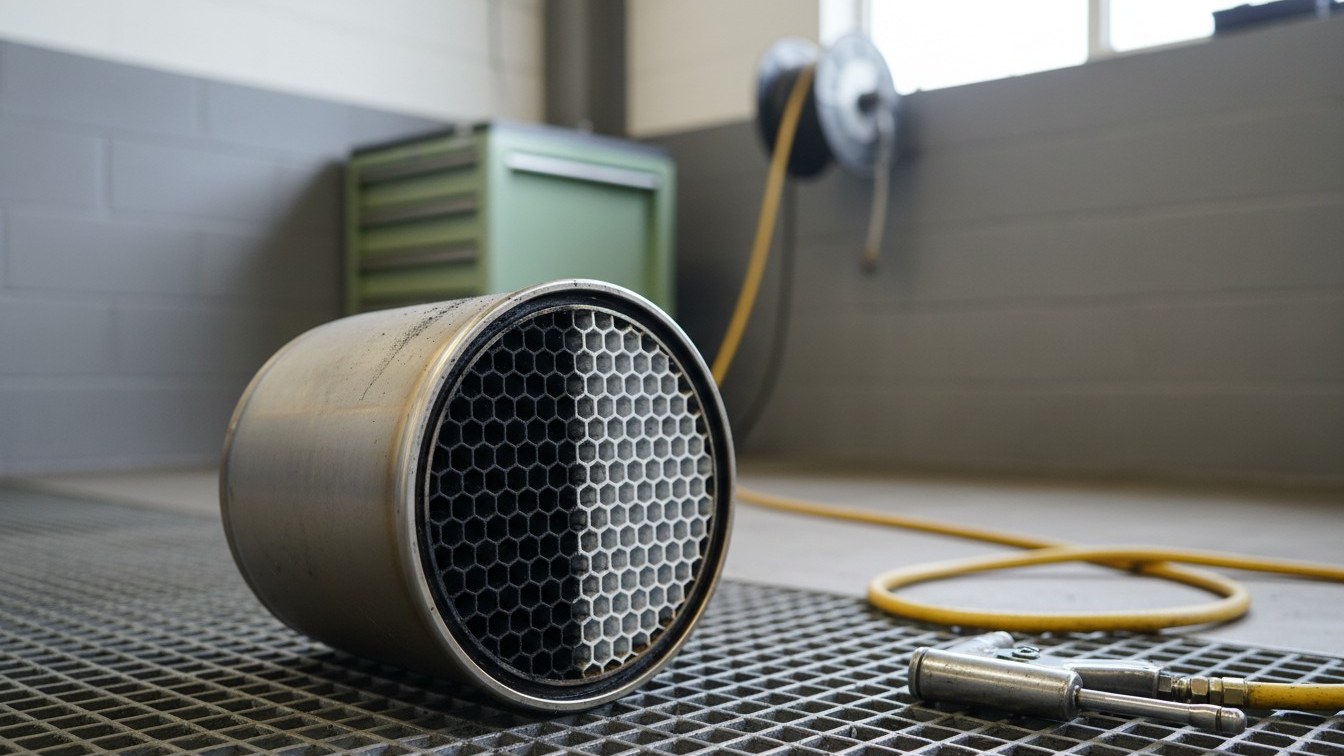
- Ash comes out only with the filter off the vehicle, blown out with compressed air, sometimes after baking in an oven3.
- Limp mode means a new DPF1, and so does a cracked or melted core: cleaning removes deposits, it cannot repair damage. At the NCT, a missing DPF is a fail11.
Soot or ash: why it decides whether cleaning works
A DPF is a soot trap. Exhaust gas is forced through the porous walls of its honeycomb channels, and the soot particles are too large to follow1. Every so often the vehicle burns the soot off, which is called regeneration (see What is a DPF and how does regeneration work?). On a vehicle that is working properly this happens roughly every 480 km (300 miles), although that varies a great deal with the vehicle and how it is driven1. The soot only ignites when the exhaust is above about 550 °C, which short journeys and stop-start driving often never reach2.
What regeneration leaves behind is ash2. It comes from three places: the additives in engine oil, which every diesel engine burns in small amounts; engine wear and rust or scale in the exhaust; and, on vehicles that use one, the regeneration additive dosed into the fuel3. It builds up for the whole life of the filter, and no regeneration removes it. Most vehicles with a DPF need a special low-ash engine oil, and the wrong oil can cause problems with regeneration1.
| Soot | Ash | |
|---|---|---|
| What it is | Particles from burning diesel | Mineral residue from engine oil, engine wear and fuel additives3 |
| Burns off? | Yes, above about 550 °C in regeneration2 | No2 |
| Removed by | A long drive, DPF cleaner, a garage regeneration | Cleaning with the filter off, or a new filter3 |
| Fault code | P246310 | P242F10 |
Five ways to clean a DPF, and one to replace it
The first five clean the filter you have; only the fifth removes ash. The sixth is a new filter.
| Method | What it does | Removes ash? |
|---|---|---|
| 1. A long, steady drive | Gets the exhaust hot enough for the filter to regenerate1,4 | No |
| 2. A DPF cleaner in the fuel tank | Helps the soot burn at a lower temperature; you still drive6,7,8 | No |
| 3. Cleaning fluid sprayed into the filter (garage) | Loosens the soot so a regeneration can burn it9 | No |
| 4. Forced regeneration (garage) | Burns the soot off when the vehicle cannot1,4 | No |
| 5. Off-vehicle cleaning (specialist) | Blows the ash out with compressed air, sometimes after baking3 | Yes |
| 6. A new DPF | No soot, no ash1 | Yes |
1. A long, steady drive
When the warning light first comes on, the filter is only partly blocked. BM Catalysts, the manufacturer of the DPFs we sell, explains it like this: when the filter is about 45% full, the engine control unit changes the fuel injection to heat the exhaust and burn the soot off. If the journey is stop-start, the regeneration cannot finish and the warning light comes on. It should normally go out after about 10 minutes at more than 65 km/h (40 mph), or up to 25 minutes if there are a lot of downhill stretches1.
Handbooks say much the same. Ford’s owner’s manual for the 1.5 TDCi diesel in the Transit Courier and Tourneo Courier asks you to drive at a steady 48 km/h (30 mph) or more for about 20 minutes, notes that each regeneration lasts 10 to 20 minutes, that the light stays on until it has finished, and that prolonged idling should be avoided4. Volkswagen tells van drivers to drive at between about 50 and 120 km/h (31 to 75 mph), within the speed limits, and to contact an authorised repairer if the light is still on after about 30 minutes5. Follow the handbook for your own vehicle.
Lots of motorway driving is not always the answer either: in sixth gear the revs can be so low that the exhaust never gets hot enough, and some harder driving in a lower gear is what burns the soot off1.
2. A DPF cleaner in the fuel tank
The bottles sold as DPF cleaner, such as Redex, JLM and Wynn’s, are fuel additives that go in the tank. Their makers say they help the soot burn at a lower temperature: Redex says its cleaner contains “a nano-metal oxide catalyst that reduces the temperature at which soot burns”6, and JLM that its cleaner lets the soot burn “at a lower temperature, when the engine is under a light load and even during shorter journeys”7. Wynn’s says its cleaner “clears and regenerates blocked soot filters without dismantling”8. None of the three says what temperature the soot then burns at, or that the cleaner removes ash, and we found no independent test of any of them.
Read the makers’ own instructions closely, because they promise less than the labels suggest:
- You still have to drive. Redex says to add a shot and “drive a few miles”, and that without the cleaner, or at least a long drive, the filter can block badly enough for limp mode6. Wynn’s advises driving more than 10 km for a complete regeneration if you normally make only very short trips8.
- One treatment, then a garage. JLM says that if one full tank does not solve the problem, you should get advice from a diesel specialist, and: “Do not keep adding additional doses as this will not help.”7 BM lists overuse of engine and fuel additives among the possible causes of the ash fault code P242F10.
- The cleaner cannot fix the cause. JLM itself names faulty EGR valves and boost pipes, the wrong or overfilled engine oil and stop-start driving as the things that stop a filter regenerating7.
Some vehicles have their own regeneration additive, dosed automatically into the fuel from a small tank, normally near the fuel tank (Peugeot’s first DPF models worked this way)1,3. On those, the first thing to check is that this tank is not empty; after refilling, the engine control unit normally has to be reprogrammed to the new level by the vehicle maker’s procedure1. A bottle of DPF cleaner is not a substitute for that additive.
3. Cleaning fluid sprayed into the filter
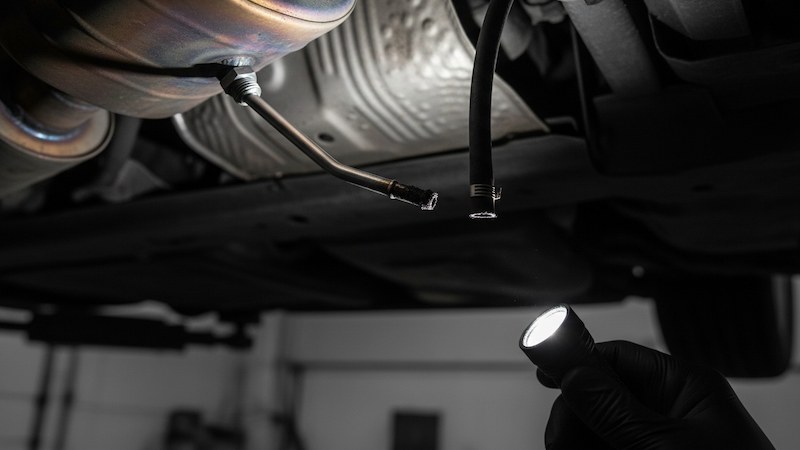
A garage can also clean the filter without removing it. In Liqui Moly’s workshop method, the temperature or pressure sensor on the filter is taken out and a probe goes in through the hole. The filter must be below 40 °C. One litre of cleaner is sprayed onto the filter in short bursts, left for about 15 minutes, then flushed with a second fluid. According to the maker, this loosens the soot and spreads it through the filter so that a normal regeneration can burn it, and the garage must start a regeneration afterwards by the vehicle maker’s procedure. Where the filter sits close to the exhaust manifold or the turbocharger, care is needed so that no fluid reaches the engine through an open exhaust valve9. Liqui Moly says the cleaning should be done by professionals, or sensitive parts can be damaged for good2.
4. Forced regeneration at a garage
If the light is ignored, or the driving still does not let the filter regenerate, the soot keeps building up. At about 75% full (it varies between makes), the regeneration has to be done by a dealer or specialist garage1; Ford and Volkswagen call this a service regeneration4,5. How it works is explained in What is a DPF and how does regeneration work? It burns soot, not ash.
At about 95% full, the engine control unit puts the vehicle into limp mode to protect the engine from the back pressure. According to BM, a regeneration can no longer be done at that point and the DPF needs replacing1.
5. Off-vehicle cleaning
Ash can only be removed with the filter off the vehicle. The Manufacturers of Emission Controls Association (MECA), the trade body of emission-control makers in the United States, described the method in a 2005 review: compressed air is blown through the channels from the outlet side while an industrial vacuum with a fine filter collects the ash on the inlet side. Sometimes the filter is first or afterwards baked in an oven at 450 to 800 °C for 3 to 12 hours to burn off any remaining soot. The cleaned filter is then checked, for example by measuring the pressure drop across it3.
The same review sets out the limits3:
- Filters with a catalytic coating should not be washed with water, and too much air pressure (over about 100 psi, 7 bar) can strip the coating.
- Steam is no good for ash: what is left can form a cement-like layer.
- Even a proper cleaning seldom gives a filter that is as good as new: in the studies MECA cites, the pressure drop came back to an acceptable level, but generally not to that of an unused filter.
No cleaning method repairs a cracked or melted filter core: all of these remove deposits, nothing more.
6. A new DPF
A new filter starts with no soot and no ash. After fitting, the fault codes are cleared, a forced regeneration is run and the engine control unit is reset1,10 (see How to replace a DPF: fitting and ECU set-up). But a new filter does not fix whatever blocked the old one. BM warns that if that cause is not found and put right, the new DPF can fail within about 480 km (300 miles)1.
When the DPF light comes on: what to do, in order
- Read the fault code. P2463 means too much soot and P242F too much ash; P2452 and P2453 point at the pressure sensor and its pipes rather than the filter10. BM’s own fault-code guide says such codes are rarely caused by a faulty DPF10. See DPF fault codes P2463, P2002, P242F, P2453 explained, or, if your dashboard says “check anti-pollution system”, Check anti-pollution system: what it means and what to do.
- Give it a proper drive as soon as you safely can, as above1,4,5.
- Find the cause if the light keeps coming back. BM asks the garage to check, among other things, the DPF pressure pipes and sensors, that the oil is the right low-ash specification, the oil level (a rising level can mean diesel in the oil from failed regenerations), the additive level where there is an additive system, the EGR valve, the temperature sensors, the air flow meter, the injectors and the glow plugs1. The full checklist is in Blocked DPF? The causes to fix before replacing it.
- Forced regeneration or in-place cleaning at a garage when the filter is too full to regenerate by itself1,9.
- Off-vehicle cleaning or a new filter when it is the ash, and a new filter when the vehicle has gone into limp mode or the filter is damaged1,3.
Clean or replace?
| Situation | What helps |
|---|---|
| DPF light on, the vehicle drives normally | A proper drive; a DPF cleaner if you like, used as its maker says1,4,6 |
| The light keeps coming back | Find the cause before anything else1 |
| Too full to regenerate by itself | Forced regeneration or in-place cleaning at a garage1,9 |
| Too much ash (P242F) | Off-vehicle cleaning or a new filter3,10 |
| The vehicle is in limp mode | A new filter1 |
| Cracked or melted core | A new filter: cleaning cannot repair it |
DPF cleaning and the NCT
The NCT checks that the emission control system fitted by the manufacturer is there and complete. A missing DPF, on a vehicle built with one, is a fail, as is a system that is “absent, incomplete, incorrectly assembled or obviously defective”11. The manual has no special rule for a cleaned filter: it is judged like any other, so it has to be in place, complete and working. If a cleaning service cut the casing open and welded it shut again, keep the paperwork: the manual says an unsafe repair or modification to the exhaust may need a modifications report11. For why taking the filter out is never the answer, see Is DPF removal or a DPF delete legal in Ireland?
Before the smoke test, the tester runs some pre-checks. If the engine warning lamp shows a fault, the smoke test is not done and the vehicle fails11. The soot and ash codes above can light that lamp10, so get a DPF fault dealt with before the test, not after it. Three other points in the NCT manual matter for a DPF diesel11:
- Warm it up by driving. The engine must be at normal temperature, warmed by normal driving rather than idling, and an engine left idling for any length of time shows a high smoke reading. A good run on the way to the test centre helps.
- Diesel in the oil is allowed for, up to a point. The manual notes that DPF regeneration can put diesel into the oil and push the level over the “max” mark. That is not a fail on a DPF vehicle unless the level is above the “X” mark on the dipstick or the dashboard warns of too much fuel in the oil.
- The smoke limits are 1.5 m-1 for diesels first registered after 1 July 2008 and 0.7 m-1 for Euro 6 engines first registered after 1 September 2015; older diesels have higher limits.
If the vehicle has already failed, Failed your NCT on emissions? What to do next explains the re-test rules and what each reading points to.
Why so many Irish diesels need this
At the end of 2022, 63% of the 2,919,005 vehicles licensed in Ireland ran on diesel, according to the Department of Transport12, and the CSO counted another 20,562 new diesel cars licensed in 202513. Both BM and Liqui Moly single out the filters on vehicles used mostly for short trips and town driving as the ones that clog1,2. If that is most of your driving, a regular longer run is the cheapest DPF cleaning there is: see How to look after your DPF and catalytic converter.
A new DPF from CatHive
If the diagnosis points to the filter itself, browse our DPFs and combined catalytic converter and DPF units; if it is the pressure sensor pipes, we also sell DPF pressure pipes. Or go straight to your vehicle, for example the Volkswagen Golf, Volkswagen Passat, Skoda Octavia, Ford Focus, Ford Mondeo, Ford Transit, Peugeot 308, Peugeot 3008, Citroën Berlingo, Kia Sportage, Nissan Qashqai, Renault Trafic, Opel Vivaro B or Mercedes Sprinter.
On our Irish shop we sell only type-approved DPFs and combined units: they are marked Type Approved and have an H at the end of the part number (see Type-approved cats and DPFs: what the law requires in Ireland). Every part lists the vehicles and years it is catalogued for, most with the engine code, so check it against your vehicle. Most come with a fitting kit, all carry a 2-year warranty (3 years on premium silicon-carbide DPFs), and they are backed by our fitment guarantee. What a new filter costs for popular vehicles is in How much does a catalytic converter or DPF cost in Ireland?
We deliver to the Republic of Ireland for €30.99 per order, whatever the size of the part. Orders placed before 4pm on a working day are normally dispatched the same day, and the courier usually takes 2 to 3 working days. Prices are in euro and are export prices, with no UK VAT: Irish VAT at 23% and any customs duty are collected by the courier before or on delivery, with its own clearance fee, and we show an estimate of the Irish VAT under each price. The details are on our Delivery page. Or enter your vehicle below to see the parts catalogued for it.
Frequently asked questions
Does DPF cleaner work?
On soot, according to its makers: it helps the soot burn at a lower temperature, and you still need to drive afterwards6,7,8. None of them says it removes ash, and JLM tells you to see a diesel specialist if one tank does not solve the problem7. We found no independent test of these products.
Can I clean a DPF myself?
You can give the vehicle a long, steady drive and, if you wish, add a cleaner to the tank as its maker directs1,4,6. Spraying fluid into the filter needs workshop equipment and a garage-started regeneration afterwards, and its maker recommends a professional2,9. Ash comes out only with the filter off and specialist equipment3.
How often does a DPF need cleaning?
The vehicle burns the soot off by itself, roughly every 480 km (300 miles) in normal use1. Ash builds up far more slowly. In 2005, MECA reported that the first European diesel models with a fuel-additive DPF were designed to have the filter serviced at 80,000 km, by replacing it with a new or an ash-cleaned one, and that newer designs had stretched that to 200,000 km3. Follow your vehicle’s service schedule.
Will a cleaned DPF pass the NCT?
The NCT has no special rule for cleaned filters. The tester checks that the emission control system is present, complete and not obviously defective, that no engine warning lamp is lit, and, on a diesel, the smoke reading11. A cleaned filter that is in place and working is treated like any other.
Is it cheaper to clean a DPF or replace it?
It depends on what is wrong. Soot can often be cleared for the price of a drive or a bottle of cleaner1,6. Ash means taking the filter off, cleaning it and refitting it3, so ask for a written price for the whole job, including the work on the vehicle, whether the ash is removed and how the result is checked, and compare it with a new filter for your vehicle. If the filter is cracked or melted, or the vehicle is in limp mode, cleaning is not an option1.
Can I just have the DPF removed instead?
No. A vehicle built with a DPF that no longer has one fails the NCT11, and the engine control unit checks that the filter is there: a pressure reading that is too low sets the code P244A10. The legal position is explained in Is DPF removal or a DPF delete legal in Ireland?
Sources (accessed 31 October 2026)
- BM Catalysts, “Diesel Particulate Filter Information & Fitting Advice” (DPFFA_V01): how DPFs work, initial investigation and diagnostic checks. bmcats.com
- Liqui Moly, “Diesel particulate filter cleaning” (information for drivers). liqui-moly.com
- Manufacturers of Emission Controls Association (MECA), “Diesel Particulate Filter Maintenance: Current Practices and Experience”, June 2005, sections 3.1, 3.4 and 3.5; published by Transport Canada. tc.canada.ca
- Ford, Tourneo Courier / Transit Courier Owner’s Manual, “Diesel Particulate Filter – 1.5L Duratorq-TDCi Diesel”. fordservicecontent.com
- Volkswagen Commercial Vehicles UK, “Diesel particulate filter warning light: particulate filter clogged with soot”. volkswagen-vans.co.uk
- Holts, “Redex DPF Cleaner” (product page, how it works and how to use it). holtsauto.com
- JLM Lubricants, “JLM Diesel DPF Particulate Filter Cleaner” (J02210, product page). jlmlubricants.co.uk
- Wynn’s Belgium, “Diesel Particulate Filter Cleaner” technical data sheet, PN 28263 (09/01/2017); copy published by a Swedish retailer. marinshopen.se
- Liqui Moly, “Pro-Line Diesel Particulate Filter Cleaner” (art. 5169): directions for workshop use. liqui-moly.com
- BM Catalysts, “DPF & Catalytic Converter Common Fault Codes Guide” (FAULTCODES_V01, January 2024). bmcats.com
- Road Safety Authority, National Car Test (NCT) Manual 2023, version 5.1 (May 2023), section 8.2.2: diesel emissions (8.2.2.1 exhaust emissions control equipment; 8.2.2.2 opacity). ncts.ie
- Department of Transport, “Irish Bulletin of Vehicle and Driver Statistics 2022” (licensed vehicles at 31 December 2022, fuel type). gov.ie
- Central Statistics Office, “Vehicles Licensed for the First Time December and Year 2025” (13 January 2026). cso.ie