The engine management light is the amber engine-shaped symbol on the dashboard, also called the engine warning light, check engine light or malfunction indicator lamp. It means the vehicle’s on-board diagnostics (OBD) system has found a fault that could push the exhaust emissions over their limits, and has stored a fault code saying what it found1. If it stays on steadily, have the code read soon. If it flashes, the engine is misfiring badly enough to damage the catalytic converter: ease off and have it checked straight away1,2. In Ireland it matters for the NCT as well: while the light shows a fault, the inspector does not carry out the emissions test, and the vehicle fails3. Most faults behind the light are not the catalytic converter or DPF, so read the code before you buy a part4. Below is what the light means, what the NCT does about it and what to do next, from the EU rules, the NCT Manual, the vehicle makers’ handbooks and the manufacturer of the parts we sell. The sources are listed at the end.
In short
- On for a few seconds when you switch on, then off: normal. The lamp is checking itself1,5.
- Steady while driving: a fault in an emission-related part has been found and a code stored. Drive gently and have the codes read soon5,6.
- Flashing: a misfire that can damage the catalytic converter. Avoid hard acceleration, keep the load light and have it seen to at once; if the vehicle shakes or loses power, stop when it is safe1,2,6.
- At the NCT: a lit engine light means no emissions test and a fail. A stored fault code on its own gives an Advisory Pass3,7.
- Clearing the code is not a repair. The light comes back when the fault does1.
What the engine management light is
On-board diagnostics came in with the Euro 3 rules of Directive 98/69/EC, which applied to new passenger vehicles from 2000 and 2001, so that a failure of the anti-pollution equipment would be detected straight away. Diesels followed more slowly: the directive itself said diesel OBD could not be fitted to all of them before 20058. How the warning lamp must behave is set out in Annex 11 of UN/ECE Regulation No 83, which EU law also applied to Euro 5 and Euro 6 vehicles1,9. It defines the “malfunction indicator” as a visible or audible indicator that clearly tells the driver about a malfunction of any emission-related component connected to the OBD system, or of the OBD system itself, and a malfunction as a failure that would take emissions over the OBD limits1. The same annex sets these rules1:
- There is one general lamp for emission problems, with the standard engine symbol, and it may not be red. Brakes, oil pressure, seat belts and the like have warning lamps of their own. That is why the engine light is amber or yellow.
- It lights when you switch the ignition on, before the engine starts, and goes out once the engine is running if no fault has been found.
- When it comes on for a fault, a fault code is stored that identifies the type of malfunction. On vehicles in service from 2005, the distance driven with the lamp on is recorded too.
- It must flash, or give some other distinct warning, whenever the engine misfires at a level likely to damage the catalytic converter.
- It may go out by itself after three driving cycles in a row without the fault, and the code may be erased once the fault has not come back in 40 engine warm-ups. So a light that has gone out can still leave a code for a garage to read.
The handbooks say the same in plainer words. Ford’s Focus handbook: “The On Board Diagnostics system has detected a malfunction of the vehicle emission control system”2. Volkswagen Ireland, using the Golf 8 as its example: “Fault in an emissions-relevant component that can damage the vehicle”6. Nissan’s Irish handbook for the Qashqai says the light “may indicate an engine control system malfunction or misfire”10. Toyota’s Corolla handbook adds a cause that is easy to miss: the lamp comes on if the fuel tank runs completely empty11.
Steady, flashing or gone out: what each means
| What you see | What it means | What to do |
|---|---|---|
| On for a few seconds when you switch on, then off | Normal: the lamp checking itself. Hyundai says it stays on for about 3 seconds; Nissan says it shows “the system is operational”1,5,10 | Nothing |
| On and steady with the engine running | A fault in an emission-related part or the engine control system has been found and a code stored1,2,6 | Drive gently and have the codes read soon. Hyundai warns that driving on with it lit may damage the emission control system5 |
| Flashing | A misfire bad enough to damage the catalytic converter (on a Ford diesel, the DPF)1,2,6 | Avoid heavy acceleration and braking and have the vehicle seen to immediately2. If it shakes or loses power, stop when it is safe6 |
| On, with a message such as “power reduced” | The engine has switched to an emergency or limp-home mode1,12 | Follow the message and the handbook. On a Nissan Qashqai, that message means stop the engine and have the vehicle towed10 |
| Came on, then went out by itself | The fault was not found again for three driving cycles. The code can stay stored for a while1 | Have the codes read anyway, and certainly before the NCT |
Diesels can work differently. Hyundai’s Tucson handbook says that on a diesel with a DPF, a blinking light may stop after driving above 60 km/h (37 mph), or in a gear above second at 1,500 to 2,000 rpm, for about 25 minutes, and that carrying on for 100 km (62 miles) with it blinking can damage the DPF5. On Volkswagen diesels the coil-shaped glow-plug lamp also warns of engine faults: on for a few seconds at switch-on is the glow plugs preheating, but on or flashing with the engine running means a fault in the engine management system13. Petrol models from the Volkswagen group also have a separate “EPC” lamp, which Škoda describes as an electronic power control fault that lets you drive on in an emergency mode, possibly with noticeably less power12. Your own handbook has the last word for your vehicle.
Can you drive with the engine management light on?
Steady, and the vehicle drives normally: usually yes, gently, and not for long before a garage reads the code. Hyundai advises having the vehicle inspected as soon as possible5, and the manufacturer of the catalytic converters we sell advises investigating any dashboard warning light as soon as it appears, because any delay could damage the catalytic converter14.
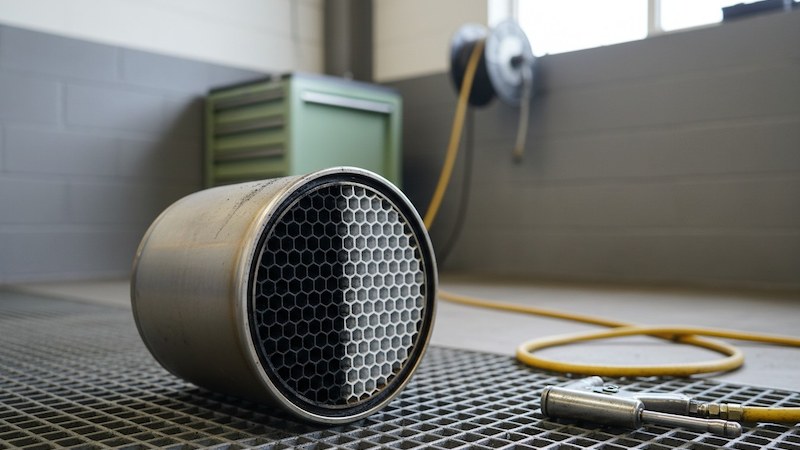
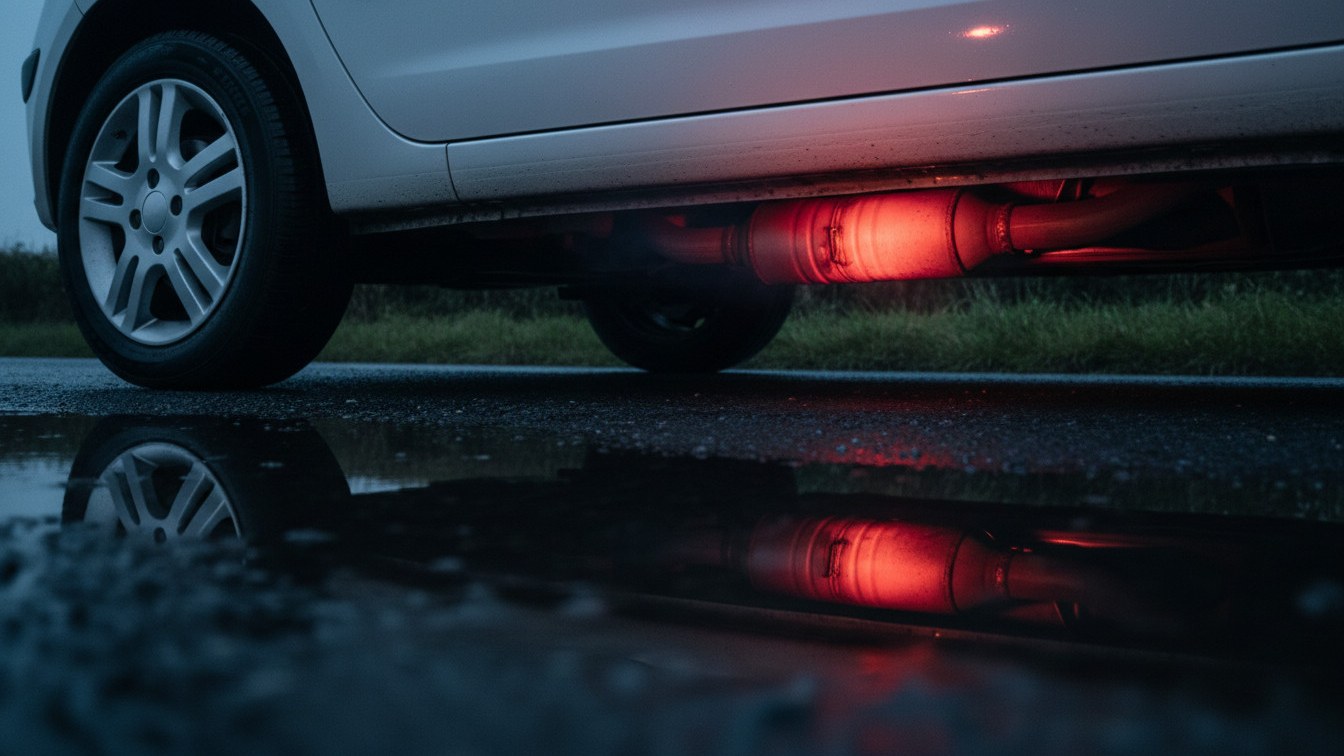
Flashing: only as far as you need to. Ford says to avoid heavy acceleration and deceleration and have the vehicle serviced immediately, because higher exhaust temperatures could damage the catalytic converter2. Volkswagen’s advice for its warning lamps is never to ignore them and to stop the vehicle as soon as possible when it is safe to do so6. What happens otherwise: unburned fuel from the misfiring cylinder ignites inside the catalytic converter, overheats its ceramic core and melts it. A converter with a blue or purple tint on its shell has usually been through this, and it is always a sign that something is wrong with how the engine runs14.
Some other warning lamps are more urgent than the engine light. Ford’s handbook, for example, says to stop as soon as it is safe and switch the engine off if the coolant temperature lamp comes on while you are driving, and not to continue your journey if the oil pressure lamp comes on2.
Whatever the light, road traffic law and your motor insurance require the vehicle to be kept roadworthy at all times, whether or not its NCT is due7.
The engine light and the NCT
The NCT emissions test starts with pre-checks. On petrol and diesel vehicles alike, if “the engine warning lamp indicates a defect in the system”, the inspector does not carry out the gas or smoke test, and the vehicle fails under the reason “oil/engine warning light remains on with the engine running”3. That is a major defect. The vehicle gets no NCT certificate until it passes a re-test, which must be booked within 21 days and done within 30 days of the test3. The diesel pre-test chart in the NCT Manual puts it plainly: with the engine or emissions warning light on, “Decline to do Smoke Test until fault rectified”3.
The OBD scan is a separate check. The inspector plugs a scanner into the vehicle’s diagnostic socket, which is usually under the steering wheel but may be in the glove box, so leave the glove box unlocked and empty and unplug any device you keep in the socket7. For now, a stored fault code that is not a reason for failure gives an Advisory Pass: the repair is strongly recommended, but the vehicle does not fail for it alone3,7. The reason for failure “OBD indicating significant malfunction” is in the Manual but “will not apply until further notice”3.
So today it is the lamp that fails a vehicle, not the code. Clearing the codes before the test turns the lamp off without repairing anything: the OBD system starts its checks again every time the engine starts and lights the lamp again when it finds the fault1, and the gas or smoke test still has to be passed. NCTS itself recommends having a garage scan the vehicle before the NCT7. If the vehicle has already failed on emissions, see Failed your NCT on emissions? What to do next.
The engine light is not the only warning lamp the NCT looks at:
| Lamp | NCT Manual section | If it shows a fault |
|---|---|---|
| Engine warning lamp | 8.2.1.2 (petrol), 8.2.2.2 (diesel) | No emissions test; major defect, fail |
| ABS | 1.6 | Major defect, fail |
| Electronic power steering | 2.6 | Major defect, fail |
| Airbag | 7.1.5 | Major defect, fail |
| Electronic stability control (ESC) | 7.12 | Major defect, fail |
| Tyre pressure monitoring (TPMS) | 5.2.3 | A system fault is a major defect on vehicles first registered from 1 January 2015, an Advisory Pass before that. A lamp lit only for low pressure is not a system fault |
| eCall | 7.13 | Minor defect: “Pending Re-Check”, with the certificate issued after a visual re-inspection |
Source for the whole table: the NCT Manual3.
What turns the light on: the codes that lead to the exhaust
Fault codes have five characters, and those starting with “P” are powertrain codes. A code does not name the part to replace: it tells the garage what to test4. The manufacturer of the catalytic converters and DPFs we sell is blunt about it: fault codes “are rarely caused by a defective catalytic converter or DPF but may cause such a defect if not properly/thoroughly investigated and resolved”4. These are the codes that most often lead to the exhaust:
| Code | What it means | Check before replacing a part |
|---|---|---|
| P0420 / P0430 | Catalyst efficiency below threshold (bank 1 / bank 2)4 | A lambda sensor fault, an air leak in the exhaust or retarded ignition timing can set it too14. See our P0420 guide |
| Misfire codes | A cylinder not firing properly. The light flashes when the misfire could damage the catalytic converter1 | Spark plugs and leads, the injection system, the lambda sensor and the MAP sensor. Unburned fuel from these faults ruins catalytic converters14 |
| P2463 | DPF restriction: soot build-up4 | Regeneration not completing, for example on town driving15, and the DPF and exhaust pressure sensors and their wiring4 |
| P242F | DPF restriction: ash build-up4 | The pressure sensor and its hoses, poor regeneration, overuse of engine or fuel additives4 |
| P2452 / P2453 | DPF pressure sensor circuit4 | The sensor, its pipes and its wiring before the DPF itself. More in DPF pressure sensor and pipes and DPF fault codes explained |
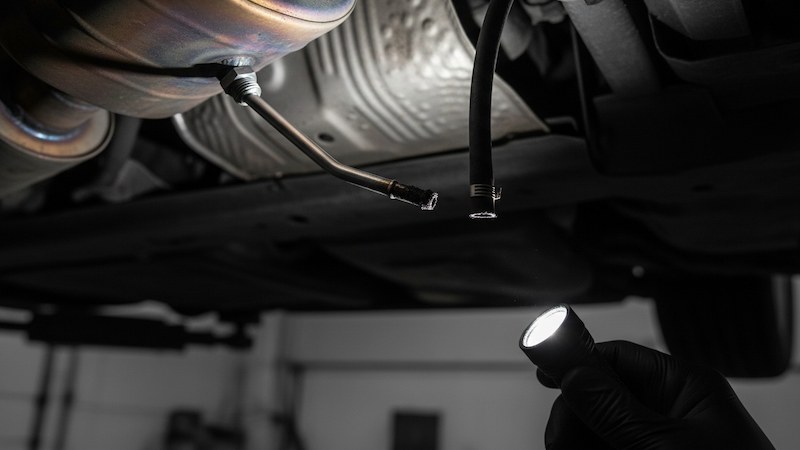
On a Renault, Dacia, Peugeot or Citroën, the engine light often comes with a “Check anti-pollution system” message: see what that message means. And on a diesel, the engine light is often the second warning, not the first. The DPF has its own warning lamp, which comes on when the filter is filling with soot and the driving has not let it regenerate. A run above 65 km/h (40 mph) for about 10 minutes, up to 25 with a lot of downhill driving, should clear it. Ignore it and other warning lights follow; at about 75% full, a garage has to force a regeneration, and at about 95% the engine goes into limp mode and the DPF needs replacing15. Our guides to why DPFs block and DPF cleaning cover that in detail; for petrol engines, see what causes a faulty catalytic converter.
What to do when the light comes on, in order
- Note how it lights: steady or flashing, with or without a message, and whether any other lamp is on. Then look up the lamp in your handbook.
- If it flashes, ease off, avoid hard acceleration and get the vehicle to a garage2. If it shakes or loses power, stop when it is safe6.
- Check the simple things: that the tank is not running on empty11, and on a diesel whether the DPF lamp is also on15.
- Have the fault codes read by a garage with a diagnostic scanner before any part is ordered. The code tells the garage what to test, not what to buy4.
- Fix the cause first. A new catalytic converter on an engine that still misfires or over-fuels will fail the same way, and its manufacturer does not cover that under warranty14.
- If a new DPF is fitted, the engine control unit must be reset or re-adapted, a forced regeneration done and the fault codes cleared, so that it recognises the new filter4.
- Then the NCT: with the fault fixed and the lamp out, drive to the test so the engine arrives at normal operating temperature3,7.
If the code points to the catalytic converter or DPF
If the diagnosis points to the part itself, browse our catalytic converters, DPFs and combined catalytic converter and DPF units, or go straight to your vehicle, for example the Toyota Corolla, Toyota Yaris, Volkswagen Golf, Skoda Octavia, Ford Focus, Ford Fiesta, Hyundai Tucson, Kia Sportage, Nissan Qashqai, Peugeot 308 or Audi A4, or pick it from the vehicle list.
On our Irish shop we sell only type-approved catalytic converters and DPFs: they are marked Type Approved and have an H at the end of the part number (see Type-approved cats and DPFs: what the law requires in Ireland). Every part lists the vehicles and years it is catalogued for, most with the engine code, so check it against your vehicle. Most come with a fitting kit, all carry a 2-year warranty (3 years on premium silicon-carbide DPFs), and they are backed by our fitment guarantee. What a new part costs for popular vehicles is in How much does a catalytic converter or DPF cost in Ireland?
We deliver to the Republic of Ireland for €30.99 per order, whatever the size of the part. Orders placed before 4pm on a working day are normally dispatched the same day, and the courier usually takes 2 to 3 working days, well inside the 30 days you have for an NCT re-test. Prices are in euro and are export prices, with no UK VAT: Irish VAT at 23% and any customs duty are collected by the courier before or on delivery, with its own clearance fee, and we show an estimate of the Irish VAT under each price. The details are on our Delivery page. Or enter your vehicle below to see the parts catalogued for it.
Frequently asked questions
Can I drive with the engine management light on?
If it is steady and the vehicle drives normally, usually yes, gently, until a garage can read the code; the handbooks ask for an inspection as soon as possible5. If it flashes, keep the load light and have the vehicle seen to immediately, because the misfire can damage the catalytic converter2. If the vehicle shakes, loses power or shows a message telling you to stop, stop when it is safe6,10.
Why is my engine light flashing?
On a petrol engine, a flashing light means a misfire bad enough to damage the catalytic converter: the rules require the lamp to switch to a distinct warning, such as flashing, for exactly that1,2. On some diesels a blinking light can mean the DPF needs a regeneration drive instead; Hyundai’s Tucson handbook is one example5. Check your handbook.
Will the engine management light fail the NCT?
Yes. If the engine warning lamp shows a fault, the emissions test is not carried out and the vehicle fails with a major defect3. Fix the fault, then book the re-test within 21 days of the test and have it done within 30 days3.
Does the NCT read fault codes?
Yes, with an OBD scanner. For now a stored code that is not a reason for failure gives an Advisory Pass rather than a fail; NCTS strongly recommends having it repaired3,7.
Why did my engine light go off by itself?
The lamp may go out after three driving cycles in a row without the fault, but the code can stay stored until the fault has not come back in 40 engine warm-ups1. An intermittent fault is still a fault, so have the codes read.
Can a catalytic converter make the engine light come on?
Yes: a catalytic converter that no longer cleans the exhaust well enough sets P0420 or P0430. But the same codes can come from a lambda sensor fault, an exhaust air leak or the ignition timing, and a converter usually fails because of a fault in the engine, so that has to be found first14.
Is the engine light the same as the DPF light?
No. The DPF warning light is a separate lamp that comes on when the filter is filling with soot and needs a regeneration; if it is ignored, other warning lights follow15. See DPF regeneration explained.
Sources (accessed 7 November 2026)
- UN/ECE Regulation No 83 (Revision 3), Annex 11 “On-board diagnostics (OBD) for motor vehicles”, paragraphs 2.5, 2.6, 3.4, 3.5, 3.6, 3.7 and 3.8.1; Official Journal of the European Union L 375, 27 December 2006. eur-lex.europa.eu
- Ford, Focus Owner’s Manual (CG3929en, August 2021), “Instrument Cluster” (p. 122) and “Starting and Stopping the Engine: Warning Lamps” (p. 187). fordservicecontent.com
- Road Safety Authority, National Car Test (NCT) Manual 2023, version 5.1 (May 2023): introduction (re-test, deficiency categorisation, Advisory Pass), sections 1.6, 2.6, 5.2.3, 7.1.5, 7.12, 7.13, 8.2.1.2 and 8.2.2.2. ncts.ie
- BM Catalysts, “DPF & Catalytic Converter Common Fault Codes Guide” (FAULTCODES_V01, January 2024): what fault codes are, P242F, P2452/P2453, P2463, P0420/P0430. bmcats.com
- Hyundai, Tucson (NX4) Owner’s Manual, 2025, “Warning and Indicator Lights”: Malfunction Indicator Light (MIL). ownersmanual.hyundai.com
- Volkswagen Ireland, “Warning and indicator lamps for combustion vehicles: Exhaust system” (example: Golf 8). volkswagen.ie
- National Car Testing Service, Frequently Asked Questions: “What is OBD Testing?”, “Will not having a completed NCT impact on my car insurance?” and preparing for the test. ncts.ie
- Directive 98/69/EC of the European Parliament and of the Council of 13 October 1998 (Euro 3 and Euro 4), recital 14 and Article 2. eur-lex.europa.eu
- Commission Regulation (EC) No 692/2008 (Euro 5 and Euro 6 type approval), Article 2(19) and Annex XI, section 2.1. eur-lex.europa.eu
- Nissan Ireland, Qashqai (J12) Owner’s Manual, 2025, “Malfunction Indicator Light (MIL) (orange)”. nissan.ie
- Toyota, Corolla Owner’s Manual (OM12F04E), section 7-2 “Steps to take in an emergency”: malfunction indicator lamp. toyota-europe.com
- Škoda Auto, “Decoding the mystery of warning lights” (Škoda Storyboard, May 2018): Engine and EPC lamps. skoda-storyboard.com
- Volkswagen UK, “Diesel engine management lamp” (glow plug lamp). volkswagen.co.uk
- BM Catalysts, “Catalytic Converter Warranty & Fitting Advice”: looking after your catalytic converter, catalyst replacement guide and warranty advice. bmcats.com
- BM Catalysts, “Diesel Particulate Filter Information & Fitting Advice”: initial investigation (DPF warning light, regeneration, limp mode). bmcats.com